


In an era defined by escalating utility rates, aging grid infrastructure, and increasingly stringent corporate ESG compliance mandates, power reliability has become synonymous with business continuity. For manufacturing plants, cold-chain logistics hubs, and commercial high-rises, even a brief 30-minute power outage can result in thousands of dollars in ruined raw materials and equipment resetting delays. While installing basic photovoltaic panels can reduce daytime electricity costs, achieving true energy autonomy requires a comprehensively and intelligently engineered solar power architecture designed to deliver continuous, stable operation under any external conditions.
Moreover, volatile global energy prices are compelling Chief Financial Officers (CFOs) and facility directors to treat energy as an active financial asset rather than a fixed overhead expense. By deploying autonomous solar architectures, businesses can insulate themselves from unpredictable grid price surges, locking in fixed and predictable Levelized Cost of Energy (LCOE) over a 25- to 30-year horizon.
The Vulnerability of Grid-Tied-Only Installations
A common misconception among commercial buyers is the belief that having solar panels on the roof guarantees power supply during regional grid failures. This is a classic misunderstanding, because - by both legal requirement and technical necessity - standard grid-tied solar inverters are equipped with "anti-islanding" protection. When the national grid goes down, the inverter immediately disconnects your solar array to prevent back-feeding into damaged utility lines, which could endanger line workers.
This means that during a blackout on a bright sunny day, a facility equipped solely with a grid-tied system will be plunged into complete darkness and rendered inoperable. To eliminate this critical vulnerability, forward-thinking enterprises are upgrading to robust commercial solar power systems that integrate dual-output hybrid inverters and high-voltage lithium energy storage. This configuration establishes an independent microgrid capable of automatically isolating your facility from grid failures within milliseconds, keeping production lines running smoothly without triggering downtime alarms.
System Architecture Comparison: Grid-Tied vs. Hybrid Lithium Battery Solutions
| Operational Capability | Standard Grid-Tied Solar System | Next-Gen Hybrid/Off-Grid Lithium Battery System |
|---|---|---|
| Power Supply During Grid Outage | No power (system shuts down) | 100% continuous backup power |
| Peak Shaving / Load Shifting | Not possible (daytime only) | Yes (stores daytime solar for nighttime use) |
| Level of Energy Independence | Low (highly dependent on the utility grid) | High (up to 100% autonomous microgrid) |
| Generator Integration | Poor / manual switchover | Seamless intelligent generator control and charging |

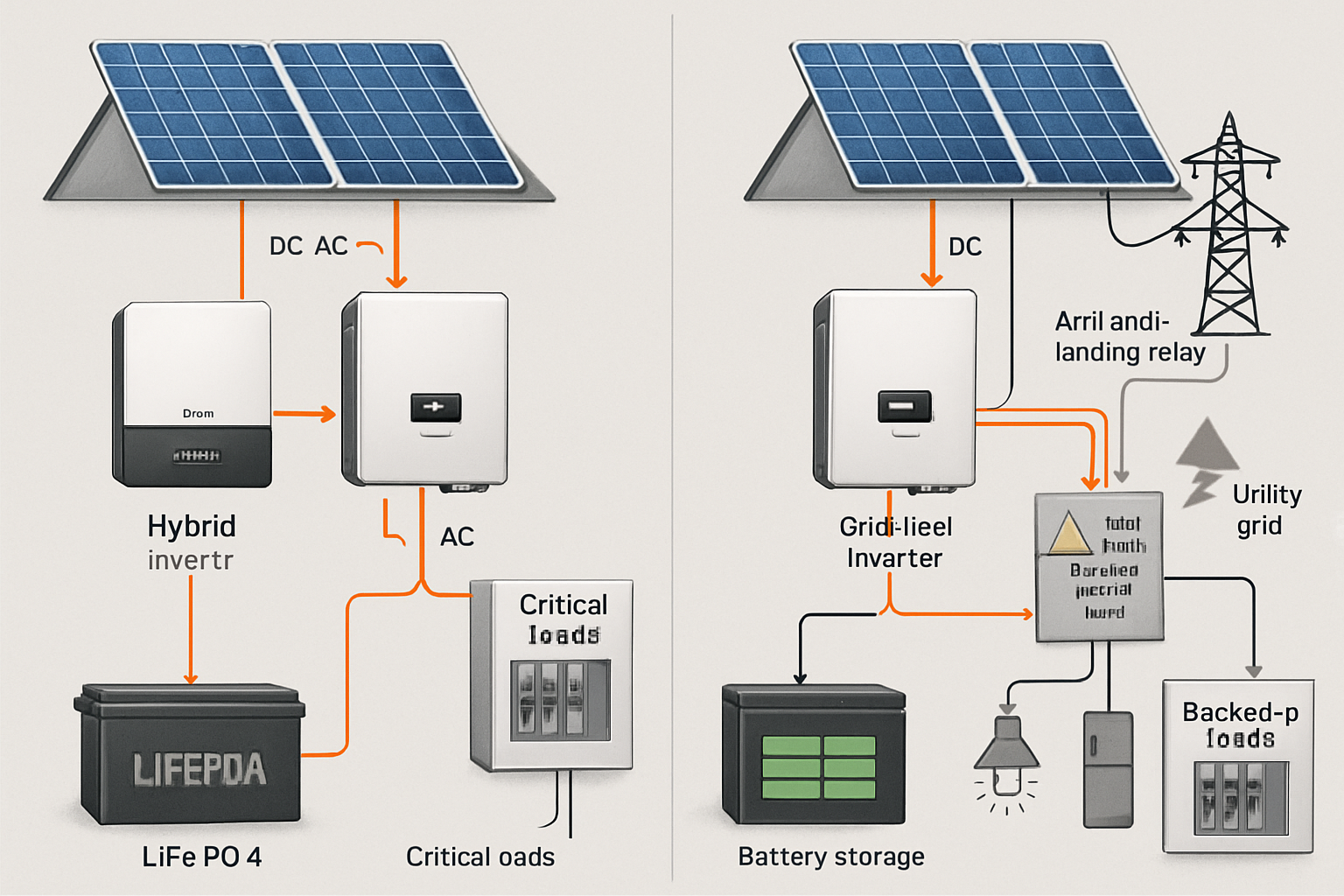
Anatomy of an Enterprise-Grade Solar Architecture
Deploying a megawatt-scale energy solution demands seamless coordination among photovoltaic generation, power conversion electronics, and electrochemical energy storage. Procuring disparate components from mismatched vendors frequently leads to communication errors between the inverter and the Battery Management System (BMS), resulting in degraded efficiency and voided warranties.
To achieve maximum operational stability, industrial engineers prioritize procuring unified, factory-matched complete solar panel systems. In this architecture, high-efficiency half-cut monocrystalline solar panels deliver high-voltage DC power to intelligent multi-MPPT hybrid inverters. These inverters dynamically route energy flows based on real-time facility demands: powering immediate operational loads, charging modular LiFePO₄ battery banks, or shaving peak demand charges during expensive Time-of-Use (TOU) rate windows.
Deep Dive: Microgrid Intelligence and MPPT Optimization
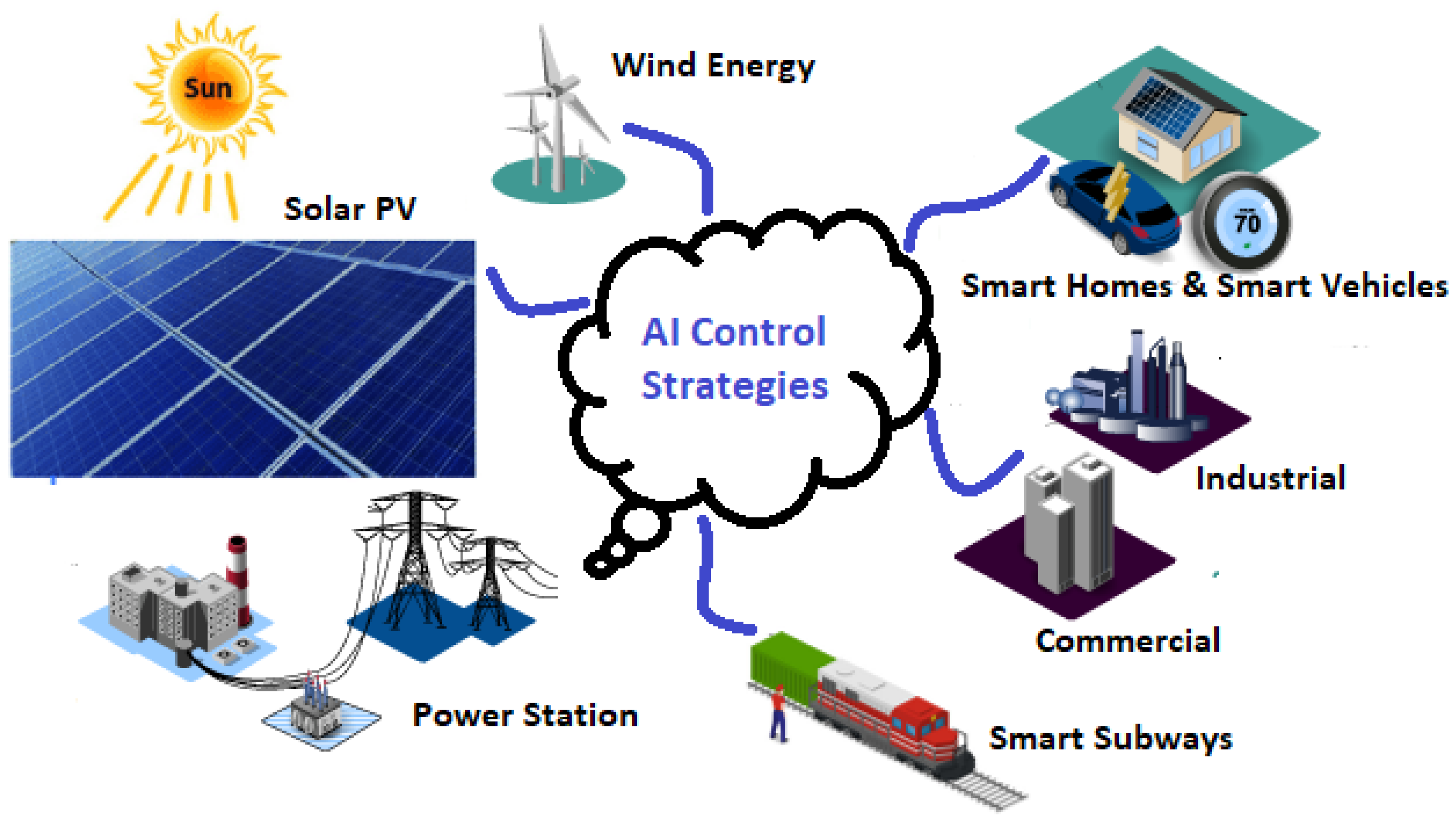
At the core of any enterprise-grade power deployment lies advanced conversion circuitry. Modern commercial hybrid inverters leverage multi-core Digital Signal Processors (DSPs) combined with ultra-fast Maximum Power Point Tracking (MPPT) algorithms. These algorithms continuously sample the solar array's voltage and current at microsecond intervals, adjusting resistive impedance to extract up to 99.5% of available energy - even under rapidly fluctuating solar irradiance caused by passing clouds.
Furthermore, intelligent microgrid management relies on bidirectional power conversion. During peak production periods, surplus DC energy is directly converted and pushed into high-voltage lithium energy storage racks with minimal thermal losses. When facility loads experience unexpected surges - such as during the simultaneous startup of industrial compressors or HVAC chillers - the system instantaneously combines grid power (or generator output) with stored battery power to meet the surge demand, protecting internal wiring and preventing circuit breaker tripping.
How to Precisely Size Commercial Energy Storage Capacity
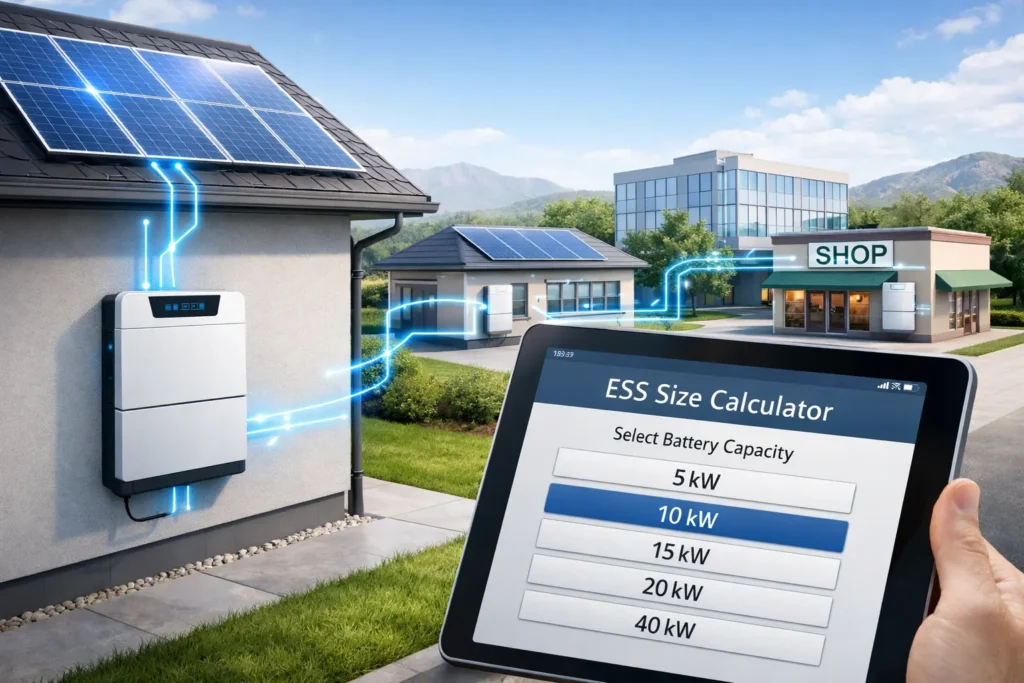
Sizing a commercial energy storage system requires a systematic engineering approach, not guesswork. An undersized battery bank will fail to support critical loads during prolonged grid outages, while an oversized deployment will unnecessarily extend the project's financial payback period. Professional EPC contractors use three primary metrics to determine battery capacity: total critical continuous load (kW), required autonomy duration (hours), and the battery's Depth of Discharge (DoD).
Engineering Formula:
Required Battery Capacity (kWh) = [Critical Load (kW) × Autonomy Duration (hours)] ÷ [Inverter Efficiency × Safe DoD]
For example, if an industrial food processing plant needs to maintain industrial refrigeration for 6 hours during a power outage, requiring 50 kW of continuous power, using premium LiFePO₄ batteries (safe DoD of 90%, inverter efficiency of 96%), the calculation would be: (50 × 6) ÷ (0.96 × 0.90) = 347.2 kWh. In this scenario, deploying a stackable 350 kWh to 400 kWh energy storage cabinet would provide a robust, fail-safe operational buffer.
Cross-Industry Applications: Where Hybrid Solar Creates Value
The versatility of modern commercial solar power architectures enables them to address unique operational challenges across diverse sectors of the global economy:
- Cold-Chain Logistics & Agriculture: Temperature-sensitive warehouses leverage solar energy storage to power large-scale refrigeration equipment during peak summer heat, preventing inventory spoilage while capitalizing on maximum daytime solar irradiance.
- Telecommunications & Data Centers: Remote cellular towers and server centers demand 99.999% uptime. Hybrid solar systems replace noisy, high-maintenance diesel generators, delivering clean, quiet, and automated backup power in remote locations.
- Mining & Remote Extraction: Off-grid industrial operations located far from utility infrastructure deploy containerized solar-plus-storage microgrids to power heavy excavation equipment and worker processing camps, dramatically reducing the logistics costs associated with transporting diesel fuel across rugged terrain.
Procurement Checklist: Choosing an Enterprise Solar Partner
When procuring high-value capital equipment for a commercial power system, evaluating a manufacturer's engineering credentials is just as important as reviewing hardware specification sheets. B2B procurement managers should verify that the system provider offers true turnkey engineering capabilities, including proprietary inverter firmware, automated battery module matching, and comprehensive short-circuit and thermal runaway protection.
Additionally, ensure the system supports modular scalability. A robust commercial architecture must allow facility managers to easily parallel additional inverter units and stack extra battery modules as factory production capacity grows - without costly rewiring or infrastructure overhauls. Procuring hardware from ISO-certified manufacturers with rigorous pre-shipment burn-in testing ensures that every individual component can withstand extreme environmental stress.
The transition to electric mobility is an irreversible trend, and robust infrastructure is the cornerstone supporting this shift. At Wenzhou Chuhan Technology, we are proud to be a Tier-1 integrator and source manufacturer in the new energy sector.
Whether you are an operator, distributor, or individual buyer, and whether you require highly reliable EV Chargers, efficient Solar Inverters, or durable Energy Storage Systems, we provide highly competitive hardware and customized solutions tailored to your needs.
Contact us today to get our latest product catalog and an exclusive quote. Let's empower global sustainable transportation together.
WhatsApp:
+86 173 6959 1971
sales07@chinachuhan.com



