Over the past decade, the global electric vehicle market has experienced explosive growth. According to the International Energy Agency's (IEA) Global EV Outlook 2026, global electric vehicle sales surpassed 20 million units in 2025, a 20% year-on-year increase, accounting for one-quarter of global new car sales. The IEA projects that global EV sales could climb further to approximately 23 million units in 2026, approaching 30% of total global new car sales. The implications of this rapid growth are profound - according to IEA data, global EVs reduced oil consumption demand by approximately 1.7 million barrels per day in 2025, a figure expected to reach about 5 million barrels per day by 2030.
However, the large-scale adoption of electric vehicles has also significantly increased electricity demand. How to produce enough electricity in a sustainable manner has become a critical challenge. In fact, the environmental impact of electric vehicles largely depends on the source of the electricity that powers them. If the electricity comes primarily from coal-fired power plants, the environmental benefits of EVs will be greatly diminished. Therefore, increasing the share of renewable energy in the power mix is essential, and solar energy, with its distributed and easily deployable characteristics, has become one of the most popular renewable energy sources for households. This article will provide an in-depth look at the basic principles of solar energy, how solar power integrates with EV charging, energy storage and smart management solutions, and future development trends - helping you gain a comprehensive understanding of how to use solar energy to charge your electric vehicle.
Can You Use Solar Energy to Charge an Electric Vehicle?
The answer is yes - you can absolutely use solar energy to charge an electric vehicle, and you don't necessarily even need smart charging capabilities. However, before diving into how it works and the benefits that smart charging can bring, let's first take a closer look at the basics of solar energy.
What Is Solar Energy?
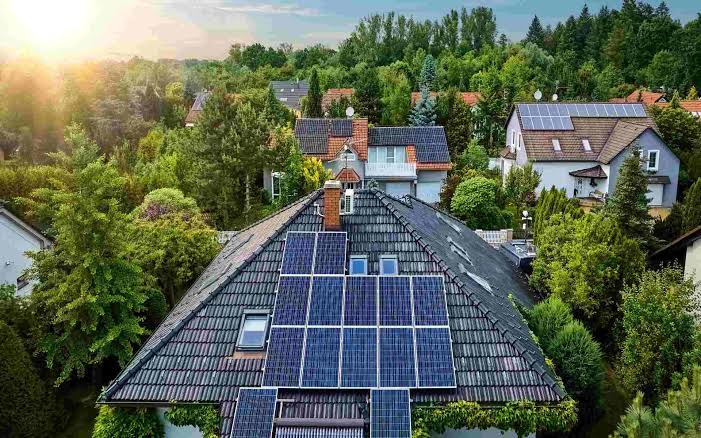
When people talk about solar energy, most think of solar panels installed on rooftops. However, from a scientific perspective, there is a fundamental distinction between "solar energy" and "solar panels." Simply put, solar energy refers to the energy radiated by the sun, a portion of which traverses the atmosphere and reaches the Earth's surface. This energy can be harnessed to generate electricity through the process of photovoltaics.
Photovoltaic (PV) panels, commonly known as solar panels, consist of hundreds of solar cells, each made from semiconductor materials (typically silicon). When the semiconductor absorbs sunlight, photons excite the electrons within, freeing them from their atomic bonds and creating an electric current - a directed flow of electrons. This electrical energy can power homes or businesses, or be fed back into the grid.
This photovoltaic process is what we commonly refer to as "solar energy," at least in the context of household energy production. In this article, we also use the term "solar panels" as a common shorthand for photovoltaic panels.
The Growing Popularity and Global Expansion of Solar Panels
The appeal of solar energy is obvious. Unlike fossil fuels, solar energy is extraordinarily abundant, available everywhere around the globe, and completely free and zero-emission during electricity generation. As a result, global solar installed capacity has achieved remarkable growth in recent years.
According to the International Renewable Energy Agency (IRENA), global newly added solar installed capacity reached 511 gigawatts (GW) in 2025, a 27.2% year-on-year increase, with solar PV accounting for nearly 75% of all new renewable energy capacity additions worldwide. By the end of 2025, cumulative global PV installed capacity had reached approximately 2.39 terawatts (TW).
The drivers behind this growth are multifaceted. On one hand, PV module costs have dropped by more than 80% over the past decade, making solar power the most economical source of electricity in an increasing number of regions. On the other hand, government policy support, carbon neutrality targets, and rising public environmental awareness have all accelerated solar adoption. Additionally, modern monocrystalline silicon PV panels have achieved conversion efficiencies of 20%–23%, meaning the same rooftop area can harvest significantly more energy.
A significant driver of this growth comes from individuals and households installing small-scale solar panels on their rooftops to reduce dependence on the grid, lower energy costs, and shrink their carbon footprint. In Europe, according to a SolarPower Europe report, in the first few weeks following the outbreak of the Middle East conflict in March 2026, solar energy saved the EU over €100 million per day in fossil fuel import costs, underscoring solar power's critical role in enhancing energy security. In certain parts of the world, solar power generation is also providing electricity to people who previously had no access. For example, in sub-Saharan Africa, off-grid solar power is having a transformative impact, enabling millions of people to access basic energy services.
How Does Solar Energy Integrate with Home EV Charging?
Solar panels alone can significantly reduce household energy expenses, and combining them with an electric vehicle amplifies both the economic and environmental advantages even further. Solar panels can generate electricity to charge an EV without relying entirely on grid power, thereby reducing charging costs and ensuring that the electricity powering the vehicle comes from a sustainable source.
While a standard residential solar system is unlikely to fully meet all of an EV's electricity needs, it can at least supplement a substantial portion of the vehicle's energy consumption. Actual output depends on your geographic location, the number and efficiency of your panels, and local weather conditions.
In Central Europe (e.g., Munich, Germany), each installed kilowatt-peak (kWp) of solar capacity generates approximately 1,100 kWh per year, or about 3 kWh per day on average. In Southern Europe (e.g., Madrid, Spain), this figure rises to approximately 1,600 kWh/year/kWp. In the United States, the range is broader: Los Angeles sees approximately 1,700 kWh/year/kWp, while Boston sees about 1,300 kWh/year/kWp.
To illustrate with a practical example: in Southern California, a typical 6-kilowatt residential solar system can generate approximately 28–30 kWh of electricity per day on a sunny day. Given that a Tesla Model 3 Standard Range consumes approximately 15 kWh per 100 kilometers (about 24 kWh per 100 miles), this solar output could theoretically add about 120–160 kilometers of range on a well-lit day - enough to cover most families' daily commuting needs.
Even in regions with less sunshine, a properly configured solar system can cover a significant portion of driving needs. In the UK, for example, a 4-kilowatt system generates approximately 3,400–3,500 kWh per year, sufficient to support an average EV driving about 18,000–20,000 kilometers annually - close to many drivers' average yearly mileage.
Do I Need a Smart Charging Station to Charge My EV with Solar Energy?
You might wonder: can you simply use the energy produced by solar panels directly to charge your car? The answer is that it's not as simple as just connecting an EV charger to solar panels. The issue is that the energy produced by PV panels is unstable and highly variable - cloud cover, changes in the sun's angle, and seasonal shifts all cause dramatic fluctuations in power output - and cannot be directly fed into an EV battery (or the grid).
Any solar panel installation must include an inverter to convert the direct current (DC) produced by the panels into the alternating current (AC) required by the household electrical system, so it can be used to power appliances or charge a vehicle. Additionally, modern solar systems are typically equipped with Maximum Power Point Tracking (MPPT) controllers, which continuously track the optimal operating point of the PV panels to ensure maximum energy harvest under varying light conditions.

Can I Store Electricity Generated by Solar Panels?
One of the major challenges with solar energy, especially for EV charging, is the mismatch between when energy is generated and when it is needed. Solar energy is primarily produced during the day when sunlight is strongest, but most people prefer to charge their EVs in the evening after returning home from work. This "temporal mismatch" is the core challenge of solar energy utilization.
Option 1: Home Battery Storage
One solution is to store the energy generated during the day and use it when needed. A home battery storage system connects to your solar panels, capturing excess generation during the day and releasing it for use in the evening or on cloudy days.
As of 2025, the cost of home battery energy storage systems has been steadily declining. In the United States, a typical residential battery storage system, including installation, costs approximately $10,000 to $20,000, depending on capacity and brand. Lithium iron phosphate (LiFePO4) batteries have become the preferred chemistry for residential energy storage due to their excellent thermal stability, longer cycle life (typically exceeding 6,000 charge-discharge cycles), and environmentally friendly cobalt-free composition.
Option 2: Net Metering
Depending on the specific policies in your area, a more cost-effective alternative is to sell excess solar electricity back to the utility company. This approach is known as net metering - excess electricity generated by your solar system during the day is fed into the grid, and when you draw power from the grid to charge your vehicle in the evening, the electricity you previously supplied is credited against your bill.
Net metering policies vary significantly by region. As of the end of 2022, 92 countries worldwide had implemented net metering policies. In the United States, many states offer net metering, though specific terms vary. In the UK, the Smart Export Guarantee (SEG) scheme allows homeowners to sell excess solar electricity to energy suppliers at prices of 4–15 pence per kWh.
It is worth noting that some regions are phasing out traditional net metering. The Netherlands has eliminated net metering to encourage battery storage adoption, and Poland has shifted from net metering to a net settlement model. These policy changes reflect a broader trend - encouraging self-consumption and energy storage rather than using the grid as a "virtual battery."
Option 3: Vehicle-to-Home (V2H) Integrated Solar
Beyond battery storage and net metering, a third energy storage approach is emerging as a cutting-edge technology. Vehicle-to-Home (V2H) systems, a form of Vehicle-to-Grid (V2G) technology, allow an electric vehicle to function as a mobile energy storage unit and deliver power back to the home grid when needed.
With V2H technology, you can effectively use your EV as a giant battery - charging the vehicle during the day when solar panels produce the most energy, and using the energy stored in the vehicle to power your home during nighttime or peak demand periods when sunlight is insufficient. An EV equipped with a 75 kWh battery could theoretically power an average household for 2–3 days during a power outage.
This field is developing rapidly. Tesla's new Model Y Performance, released in late 2025, officially supports bidirectional charging, enabling both V2H and Vehicle-to-Load (V2L) functions. Paired with the Tesla Powerwall 3 and a compatible bidirectional inverter, the system can achieve seamless energy flow between the vehicle, the home, and the grid. The additional cost for V2H hardware and installation is estimated at approximately $1,000–$2,500.
The global V2H inverter market was valued at $1.29 billion in 2024 and is projected to grow at a compound annual growth rate of 18.4%, reaching approximately $5.45 billion by 2033. DENSO, Siemens, Mitsubishi Electric, ABB, Schneider Electric, and Nissan are among the major players in this field.
Currently, V2H and V2G systems are still in a stage of rapid development and gradual adoption and have not yet been widely deployed. However, they are critical to our energy systems, capable of unlocking battery storage potential on a much larger scale and enabling people to access renewable energy around the clock more conveniently.

Government Incentives for Solar Energy
Governments around the world are seeking to accelerate the transition away from fossil fuels, and many offer incentives for homeowners to install renewable energy systems, including solar power generation.
These incentives can take various forms: direct subsidies or grants to cover part of the installation cost (for example, Australia's "More Affordable Home Batteries" program offers approximately a 30% discount on home battery systems); tax credits (such as the U.S. Federal Residential Clean Energy Credit, which provides a 30% tax credit for eligible solar and battery storage systems, valid through 2032); more favorable net metering or feed-in tariffs; energy tax exemptions or property tax exemptions; and low-interest financing programs designed specifically for clean energy investments.
The subsidies available from your national, regional, and local governments can vary significantly, but generally speaking, these incentives can substantially reduce the cost of installing solar panels on your home. Additionally, many countries and regions offer various incentives for installing EV charging stations, and if you use solar energy to charge your EV, these policies will further lower your overall investment.
It is recommended that you thoroughly research all available subsidies and incentive programs in your area before making an investment decision. In the United States, DSIRE (the Database of State Incentives for Renewables & Efficiency) provides comprehensive, up-to-date information on federal, state, and local incentives.
FAQ
Q: How many solar panels do I need to charge an EV at home, and what is the payback period?
A: This depends on your daily driving distance, local sunshine conditions, and panel wattage. In Central Europe, for example, a 6-kilowatt rooftop solar system (approximately 15–18 modern 350–400-watt panels) generates about 6,600 kWh per year, sufficient to support an average EV driving approximately 35,000–40,000 kilometers annually. In the United States, the installation cost of a 6-kilowatt system is approximately $18,000–$30,000; after the 30% federal tax credit, the net cost is approximately $12,600–$21,000. In Europe, costs are typically lower, at approximately €1,200–€1,500 per kWp in Germany. The payback period is typically between 6 and 10 years, after which your vehicle's "fuel" is essentially free.
Q: What happens on cloudy days or during winter when sunlight is limited?
A: On cloudy days or during winter, PV panel output may drop to just 10%–30% of sunny-day levels. However, you can address this in three ways: first, through net metering - selling electricity to the grid on sunny days and drawing from it on cloudy days; second, by installing a home battery to store excess energy; and third, the system automatically switches to grid power when solar generation is insufficient. From an annual perspective, a properly configured solar system can typically cover 60%–80% of annual charging needs, with only minimal grid supplementation required in winter.
Q: Is V2H (Vehicle-to-Home) technology available now?
A: V2H is transitioning from the pilot phase to early commercialization. As of 2025–2026, vehicles such as the Tesla Model Y Performance, Ford F-150 Lightning, Nissan Leaf, and Hyundai Ioniq 5 already support bidirectional charging. However, V2H requires vehicle hardware support, a dedicated bidirectional inverter, and an energy management system, with additional costs of approximately $1,000–$2,500. It is expected that within the next 3–5 years, bidirectional charging will become a standard feature on mid-to-high-end electric vehicles.
The transition to electric mobility is an irreversible trend, and robust infrastructure is the cornerstone supporting this shift. At Wenzhou Chuhan Technology, we are proud to be a Tier-1 integrator and source manufacturer in the new energy sector.
Whether you are an operator, distributor, or individual buyer, and whether you require highly reliable EV Chargers, efficient Solar Inverters, or durable Energy Storage Systems, we provide highly competitive hardware and customized solutions tailored to your needs.
Contact us today to get our latest product catalog and an exclusive quote. Let's empower global sustainable transportation together.
WhatsApp:
+86 173 6959 1971
sales07@chinachuhan.com