

First, a quick recap: Why did you choose LFP?
Just to refresh your memory:
| Feature | LFP | NMC |
|---|---|---|
| Safety | Very high - no thermal runaway | Lower - risk of overheating |
| Cycle life | 4,000–6,000+ cycles | 2,000–4,000 cycles |
| Energy density | Lower (heavier for same capacity) | Higher (lighter, more compact) |
| Cost |
Generally lower |
Generally higher |
You chose LFP for safety and longevity. Smart move.
What is a BMS, and why should you care?
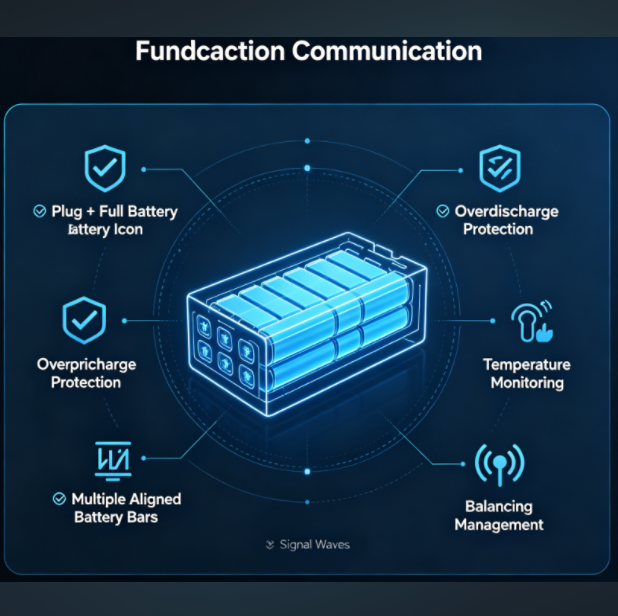
A BMS is the brain inside your battery pack. It continuously monitors and protects your battery cells. Think of it as a 24/7 security guard plus a performance optimizer, all in one tiny circuit board.
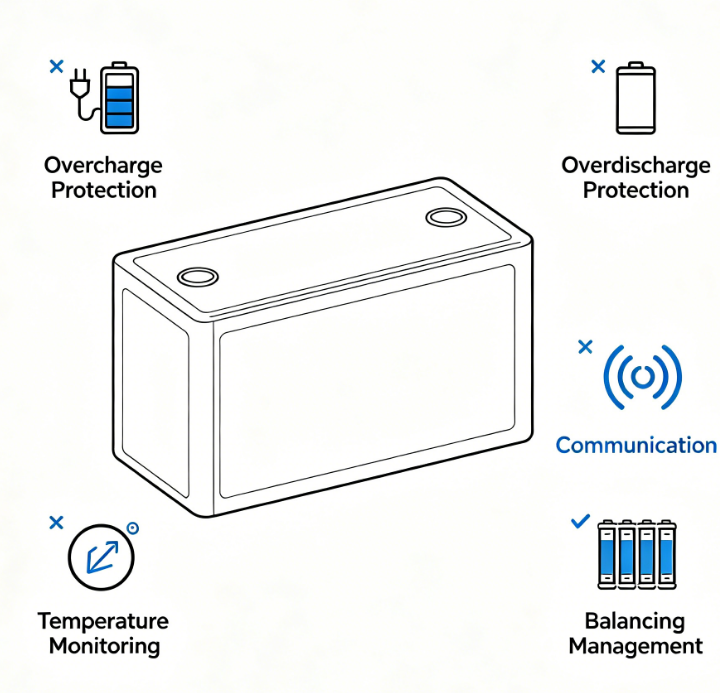
A good BMS does five critical things:
| Function | What it does | Why it matters to you |
|---|---|---|
| Overcharge protection | Stops charging when any cell reaches max voltage | Prevents fire and cell damage |
| Over-discharge protection | Stops discharging when any cell hits minimum voltage | Prevents permanent battery death |
| Temperature monitoring | Shuts down if battery gets too hot or too cold | Prevents thermal issues, extends life |
| Cell balancing | Keeps all cells at the same voltage level | Maximizes usable capacity |
| Communication | Talks to your inverter about state of charge, health, etc. | Gives you real data, not guesses |
Without a good BMS, your LFP battery is like a car without brakes. It might work - until something goes very wrong.
The "dumb BMS" vs "smart BMS" trap
Not all BMS are created equal. Many budget batteries use what we call a "dumb BMS" :
| Feature | Dumb BMS | Smart BMS (What we use) |
|---|---|---|
| Basic protection (over/under voltage) | ✅ Yes | ✅ Yes |
| Cell balancing | 🔶 Passive only (wastes excess as heat) | ✅ Active or high-quality passive |
| Temperature monitoring | 🔶 One sensor for whole pack | ✅ Multiple sensors per cell group |
| Communication with inverter | ❌ No (just basic on/off signal) | ✅ Yes (CAN, RS485, Bluetooth) |
| State of charge accuracy | ❌ Guess (voltage-based, often wrong) | ✅ Coulomb counting + self-learning |
| Remote monitoring | ❌ No | ✅ Yes (app, sometimes web) |
The result? With a dumb BMS, your 10kWh LFP battery might only deliver 7-8 usable kWh. And you will have no idea why. With a smart BMS, you get full usable capacity and real-time visibility.
How to pair BMS with your LFP battery: 3 key matching rules
Not every BMS works well with every LFP battery. Here is what you need to check:
Rule 1: Continuous current rating must match your inverter
Your BMS needs to handle the maximum current your inverter draws.
Quick formula:
Current (Amps) = Power (Watts) ÷ Voltage (Volts)
Example: A 5kW inverter at 48V draws about 104A. Your BMS should be rated for at least 120A continuous (with headroom).
Rule 2: Number of cells in series must match BMS channels
LFP cells are typically 3.2V each. A 48V battery needs 15 or 16 cells in series (15S or 16S). Your BMS must support exactly that configuration.
Rule 3: Communication protocol must match your inverter
This is the most overlooked rule. Your BMS and inverter need to "speak the same language."
| Common Protocol | Used By |
|---|---|
| CAN bus | Many hybrid inverters (Deye, Sol-Ark, Victron) |
| RS485 | Growatt, GoodWe, some SMA models |
| Pylontech protocol | Widely adopted as an unofficial standard |
Ask your supplier: "Does your BMS communicate with my inverter model?" If the answer is "no" or "maybe," keep looking.
Capacity management: Moving beyond "how many kWh"
Choosing the right capacity (which you already did - good job) is just the start. Managing that capacity intelligently is what separates a frustrating system from a satisfying one.
Here is what smart capacity management looks like:
1. Usable capacity vs nameplate capacity
A "10kWh" battery rarely gives you 10kWh. Why?
BMS reserves a small buffer (usually 5-10%)
Inverter efficiency losses (typically 5-8%)
Temperature effects (cold reduces available capacity)
A smart BMS tells you actual usable capacity, not just theoretical nameplate.
2. State of Charge (SoC) accuracy
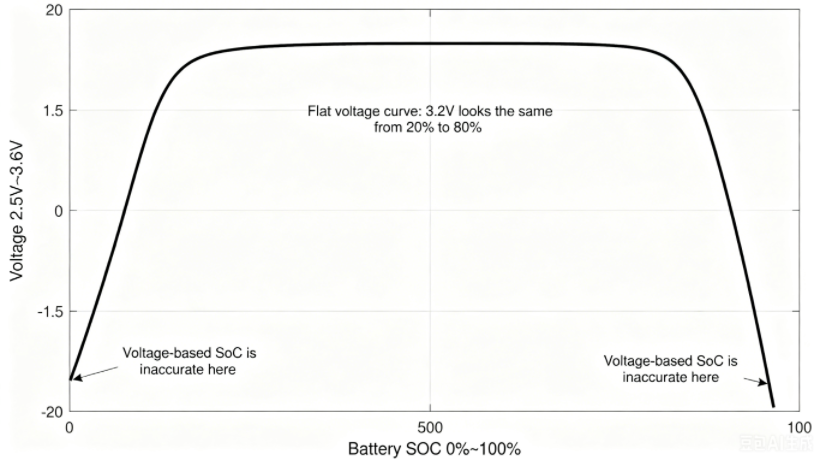
Voltage-based SoC (cheap BMS) is wildly inaccurate with LFP. Why? LFP has a very flat voltage curve - 3.2V looks almost the same from 20% to 80% charge.
Smart solution: Coulomb counting (measuring actual current in and out) plus periodic voltage calibration. Accuracy improves from ±15-20% to ±3-5%.
3. Depth of Discharge (DoD) management
LFP batteries are happy to discharge to 80-90% DoD daily. But for maximum cycle life, here is a simple guideline:
| Daily DoD | Expected Cycle Life |
|---|---|
| 80% (use 8kWh of a 10kWh battery) | 6,000+ cycles (~16 years) |
| 90% | 4,000-5,000 cycles (~11-14 years) |
| 100% (emergency only) | 2,500-3,000 cycles (~7-8 years) |
A smart system lets you set your preferred DoD - maximize daily capacity or prioritize longevity.
What Chuhan Technology delivers
When you choose a Chuhan Technology LFP home storage system, you are not just buying battery cells. You are getting an integrated smart energy management system:
Our BMS features:
✅ Active cell balancing - no wasted capacity
✅ Multi-point temperature sensing - no hot spots
✅ CAN bus and RS485 communication - works with major inverter brands
✅ Bluetooth and WiFi monitoring - check your system from anywhere
✅ Coulomb counting SoC - accurate to ±3%
Our capacity management features:
✅ Adjustable depth of discharge (80% / 90% / 100% modes)
✅ Time-of-use scheduling - charge when electricity is cheap
✅ Remote firmware updates - your BMS gets smarter over time
✅ Real-time app dashboard - see voltage, current, temperature, SoC, and estimated runtime
The result? You get every kilowatt-hour you paid for. You know exactly what is happening with your battery. And you can trust your system to last 10-15 years.
A quick checklist before you buy your LFP battery system
Use this when talking to any supplier (including us - we welcome tough questions):
| Question | Why It Matters |
|---|---|
| Does the BMS have active balancing? | Passive balancing wastes energy and leaves capacity on the table |
| What communication protocols are supported? | Must match your inverter, or you lose smart features |
| Can I monitor the system from my phone? | You need real data, not guesswork |
| What is the continuous discharge current rating? | Must exceed your inverter's max draw |
| Is depth of discharge adjustable? | Lets you choose between max daily capacity and max cycle life |
| What is the accuracy of the SoC reading? | ±5% or better is good; ±3% is excellent |
Bottom line: LFP + smart BMS + intelligent capacity management = true energy independence
You made the right choice going with LFP. Now finish the job.
A great battery with a poor BMS is a frustrating, underperforming system. An average battery with a great BMS can still deliver reliable, predictable performance every day.
At Chuhan Technology, we don't sell "just batteries." We sell complete, smart energy storage systems - designed, tested, and supported as one integrated solution.
Ready to take the next step?
Contact our team. Tell us your inverter model and daily energy needs. We will recommend the right LFP + BMS combination - fully pre-configured and ready to install.
Because your home deserves more than just a battery. It deserves intelligence.


