

You all have one thing in common: how do you power your devices when you're away from the grid?
Phones need charging. Laptops need to run. Rice cookers need to make dinner. Refrigerators need to keep food cold. Air conditioners need to beat the heat.
The answer is an inverter.
It converts DC power from your battery (12V/24V/48V) into AC power (110V/220V) that household appliances can use.
But here's the question: 1000W, 3000W, or 5000W - which one do you choose?
Buy too small - your appliances won't run. The inverter will trip the moment you turn on the kettle.
Buy too big - you spend more money, take up more space, and the inverter wastes more power just by being on.
This guide will help you figure it out once and for all.
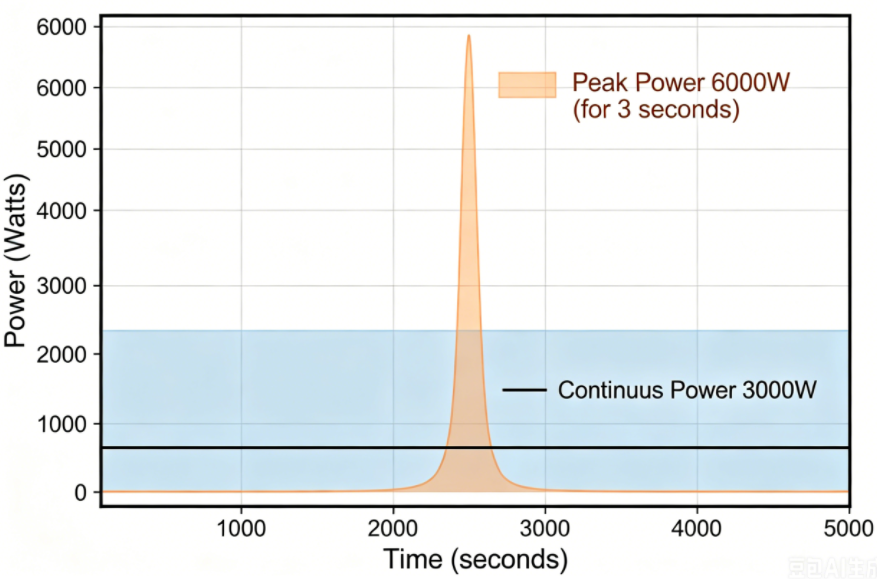
Step 1: Two critical concepts - Continuous Power and Peak Power
This is the most common mistake when shopping for inverters.
| Concept | What It Means | Why It Matters |
|---|---|---|
| Continuous Power (Rated Power) | The power an inverter can deliver indefinitely | Determines how many appliances you can run at the same time |
| Peak Power (Surge Power) | The power an inverter can deliver for a few seconds (typically 3-10 seconds) | Determines whether you can start motors, compressors, and pumps |
Example:
An inverter labeled "3000W" usually means:
Continuous power: 3000W (can run 3000W of load all day)
Peak power: 6000W (only for a few seconds - enough to start heavy appliances)
Why does peak power matter?
Because appliances with motors or compressors (refrigerators, AC units, pumps, power tools) draw 3 to 7 times their normal running current when starting up.
| Appliance Type | Running Power | Starting Power (Peak) |
|---|---|---|
| Household refrigerator | 150W | 600-900W (4-6x) |
| 1 HP window AC (about 9,000 BTU) | 800W | 2400-3000W (3-4x) |
| Water pump | 500W | 1500-2500W (3-5x) |
| Angle grinder | 1000W | 3000-5000W (3-5x) |
Your inverter's continuous power must handle all running appliances. Its peak power must handle the largest starting surge.
Step 2: List your appliances and calculate total power
Grab a piece of paper. Write down every appliance you plan to run at the same time.
Common off-grid appliance power reference table:
| Category | Appliance | Running Power (approx) | Starting Power (approx) | Notes |
|---|---|---|---|---|
| Low Power | Phone charger | 5-10W | None | Multiple at once is fine |
| LED light bulb | 5-15W | None | Very low draw | |
| Router / signal booster | 10-20W | None | Often left on 24/7 | |
| Laptop | 40-80W | None | Varies by model | |
| 12V compressor fridge | 40-60W | 120-200W | Has starting surge | |
| Medium Power | Fan | 30-50W | None | Small AC fan |
| TV (32-inch LCD/LED) | 40-60W | None | Modern TVs are efficient | |
| Electric blanket | 50-100W | None | Resistive load | |
| Rice cooker (3-cup) | 400-600W | None | Runs for ~30 minutes | |
| Microwave oven | 800-1200W | None | Also has some surge | |
| Hair dryer | 1000-1500W | None | Very high draw | |
| Electric kettle | 1000-1500W | None | 5 minutes to boil | |
| High Power | Electric pressure cooker | 700-1000W | None | Great for off-grid cooking |
| Coffee maker (drip) | 800-1200W | None | Espresso machines similar | |
| 1 HP window AC | 700-900W | 2400-3000W | Large starting surge | |
| 2 HP window AC | 1400-1800W | 4800-6000W | Rare in RVs | |
| Angle grinder / drill | 800-1200W | 2400-4000W | Tool surge is high | |
| Water pump | 400-800W | 1500-2500W | Common on boats and RVs |
Calculation steps:
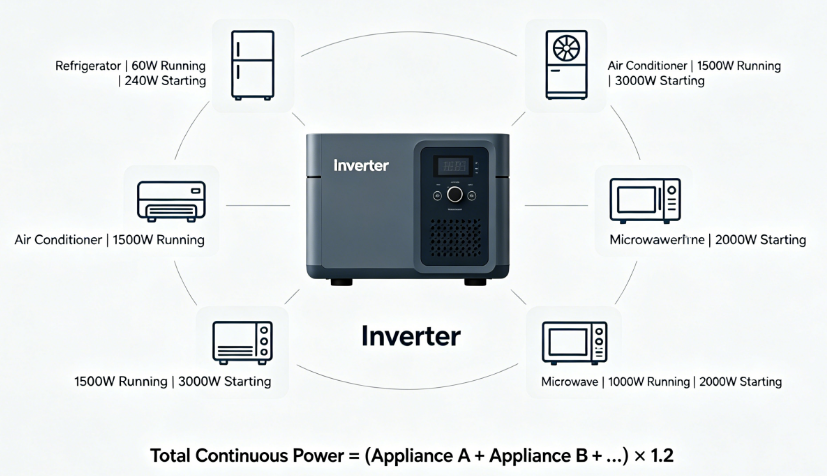
Continuous power needed = (Sum of running watts of all appliances that may run at the same time) × 1.2 (20% safety margin)
Peak power needed = Starting watts of the largest motor-driven appliance + running watts of all other appliances running at the same time
Example - a typical RV scenario:
Simultaneously running: 12V fridge(60W) + laptop(60W) + 3 LED lights(15W) + phone charging(10W) = 145W
Then you turn on the electric kettle (1500W):
Continuous power needed = (145 + 1500) × 1.2 ≈ 1974W
Then you want to start the AC (running 800W, starting 2400W) while the kettle is still on:
Peak power needed = 2400 (AC starting) + 145 + 1500 = 4045W
Conclusion for this scenario: You need an inverter rated for at least 2000W continuous and 4000W peak. A "3000W" inverter (with 6000W peak) would work perfectly.
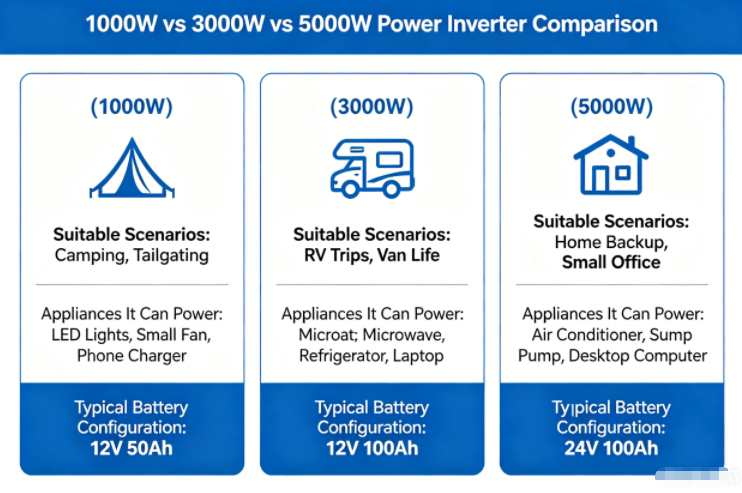
Step 3: 1000W vs 3000W vs 5000W - Direct recommendations
| Inverter Power | Best For | What It Can Run | Typical Battery | Budget Level |
|---|---|---|---|---|
| 1000W | Light camping, backpacking, motorcycle trips | Phone, laptop, LED lights, small fan, small 12V fridge | 12V 100Ah | Low |
| 1000-2000W | Weekend camping, small RVs, small fishing boats | Above + rice cooker, small hair dryer, small kettle | 12V 200Ah or 24V 100Ah | Low-Medium |
| 2000-3000W | Full-size RVs, family camping, fishing boats | Above + 1 HP AC (with soft start), microwave, full kettle, coffee maker | 24V 200Ah or 48V 100Ah | Medium |
| 3000-5000W | Large family RVs, off-grid cabins, work boats | Everything above + 2 HP AC, pressure cooker, large pumps, power tools simultaneously | 48V 200Ah+ | High |
Detailed decision guide:
Choose 1000W (light camping)
You only bring phone, laptop, a few LED lights
You don't cook with electricity (use propane or campfire)
No AC
Pros: Cheap, small, low standby draw
Cons: Basically no heating appliances
Choose 1000-2000W (weekend warrior)
You want to occasionally use a rice cooker or small kettle
You have a small fridge
No AC
Pros: Covers most camping needs, best value
Cons: Cannot run AC or large kitchen appliances
Choose 2000-3000W (RV mainstream)
You want to use electricity like at home while RVing
You have a 1 HP AC (needs soft starter or high-peak inverter)
You want to run microwave, kettle, and rice cooker
Pros: True "power freedom"
Cons: More expensive, requires larger battery bank
Choose 3000-5000W (heavy user / off-grid cabin)
You have a 2 HP AC, large water pump, power tools
Or a large family using power simultaneously
Or your work boat has multiple high-power devices
Pros: Run anything you want
Cons: Expensive, heavy, large, high standby draw
Step 4: Don't forget the battery - inverter size must match battery capacity
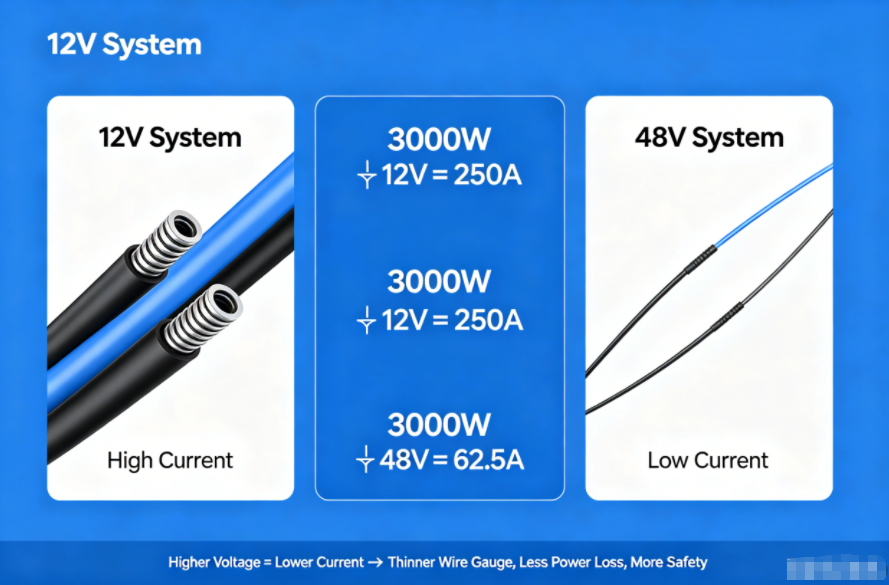
One often-overlooked fact: The bigger your inverter, the more current your battery must deliver.
| Inverter Power | Current at 12V | Current at 24V | Current at 48V |
|---|---|---|---|
| 1000W | ~83A | ~42A | ~21A |
| 2000W | ~167A | ~83A | ~42A |
| 3000W | ~250A | ~125A | ~63A |
| 5000W | ~417A | ~208A | ~104A |
Formula: Current (A) = Power (W) ÷ Voltage (V) ÷ 0.9 (assuming 90% inverter efficiency)
Battery sizing recommendations:
| Inverter Power | Minimum Battery Capacity (12V system) | Recommended Configuration |
|---|---|---|
| 1000W | 100Ah (1 hour runtime at full load) | 12V 100Ah ×1 |
| 2000W | 200Ah (1 hour runtime) | 12V 200Ah ×1 or 12V 100Ah ×2 parallel |
| 3000W | 300Ah (1 hour runtime) | 24V system better: 24V 200Ah |
| 5000W | 500Ah (1 hour runtime) | 48V system much better: 48V 200Ah |
Important: Your battery's maximum continuous discharge current must be higher than what the inverter requires. Ask your battery supplier: "What is this battery's maximum continuous discharge current?"
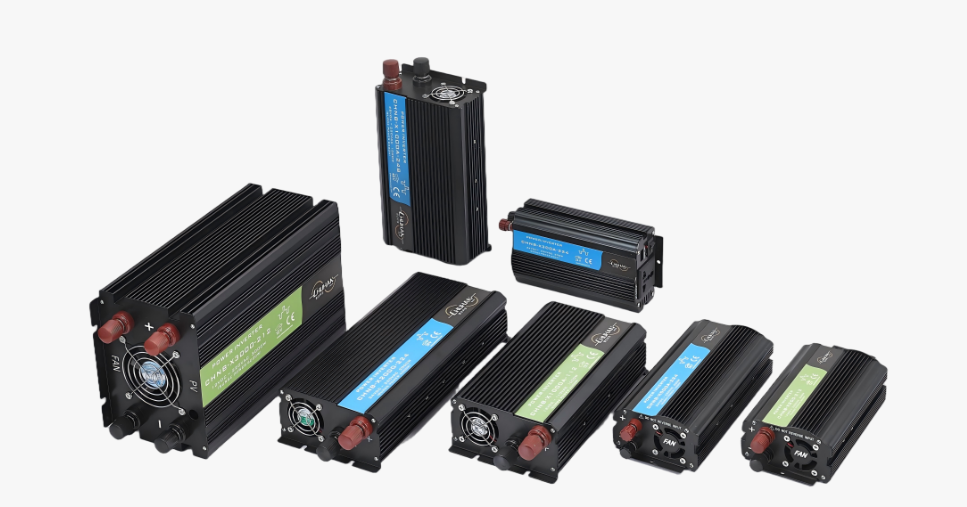
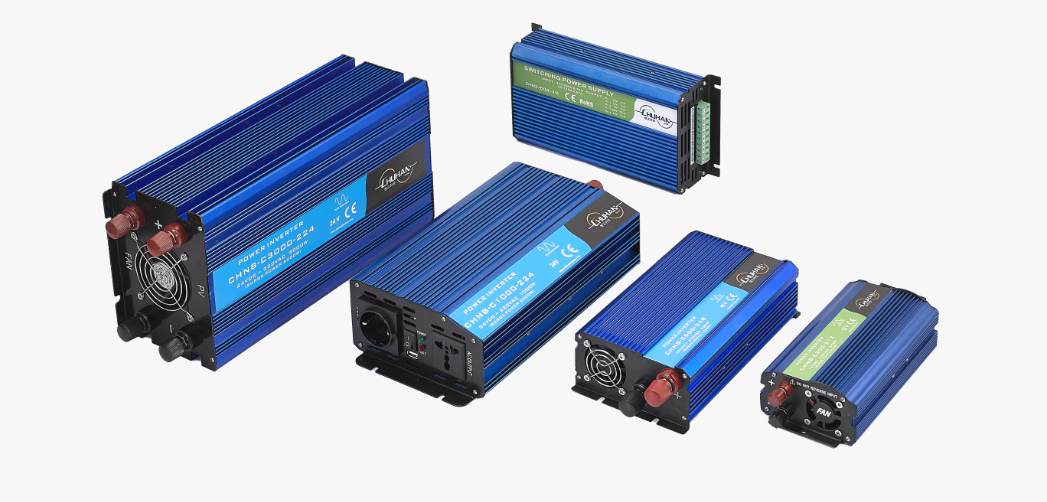
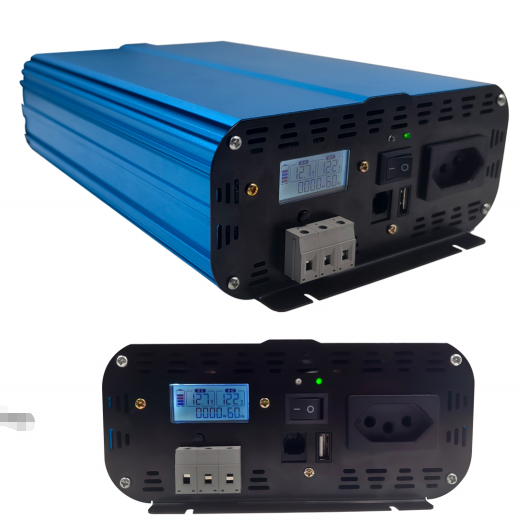
Chuhan Technology's Mobile/Off-Grid Inverter Recommendations
At Chuhan Technology, we offer a complete line of inverters for different off-grid needs. Here is our product family explained simply:
| Series | Waveform | Rated Power Range | Best For | Key Feature |
|---|---|---|---|---|
| CHNB-M (Mini) | Modified Sine Wave | 500W – 1500W | Light camping, basic electronics (lights, fans, phone charging) | Smallest size, most affordable |
| CHNB-X (Modified) | Modified Sine Wave | 100W – 3000W | Simple resistive loads (lamps, fans, TVs, radios) | Wide power range, budget-friendly |
| CHNB-C (Pure Sine) | Pure Sine Wave | 300W – 6000W | All appliances - including sensitive electronics, motors, compressors, pumps, power tools | Recommended for most users - clean power for everything |
| CHNB-E (Pure Sine + LCD) | Pure Sine Wave | 1000W – 2000W | Same as C series, plus remote control and real-time monitoring | LCD display, remote ON/OFF, Modbus communication |
Which series should you choose?
Quick decision guide:
| If you need... | Choose... | Why |
|---|---|---|
| Lowest cost, simple devices only (lights, fans, phone chargers) | CHNB-M or CHNB-X | Modified sine wave is cheaper - but cannot run motors or sensitive electronics reliably |
| To run everything - laptops, TVs, refrigerators, AC units, pumps, power tools | CHNB-C | Pure sine wave (THD < 3%) - clean power like grid electricity |
| Pure sine wave + monitoring + remote control | CHNB-E | Same clean power as C series, plus LCD display and remote ON/OFF capability |
Important reminder: Modified sine wave inverters (M and X series) work fine for simple devices like incandescent lights, fans, and phone chargers. However, they may cause issues with:
Laptop chargers (overheating, buzzing)
Refrigerators and AC units (inefficient operation, potential damage)
Power tools (reduced torque, overheating)
Any device with a motor or compressor
For RVs, camping, fishing boats, and off-grid living - we strongly recommend pure sine wave (C or E series). Your appliances will thank you.
Quick Checklist: 5 Questions to Ask Before Buying an Inverter
| Question | Your Answer Tells You |
|---|---|
| 1. Will I run an AC unit? If yes, what size? | With AC → at least 2000W, pay close attention to peak power |
| 2. Will I run kettle/rice cooker/microwave at the same time? | Simultaneous high-power cooking → go bigger on wattage |
| 3. What is my battery voltage (12V/24V/48V)? | Determines which input voltage inverter you need |
| 4. Can my battery deliver enough current? | Required current = Inverter power × 1.1 ÷ Battery voltage |
| 5. What is my budget? | Determines which series fits you best |
Summary: How to Choose Without Regret
A foolproof selection process:
Make a list - All appliances you may run simultaneously
Calculate power - Continuous (running) + Peak (starting surge)
Size the inverter - Continuous ≥ Total running watts × 1.2, Peak ≥ Largest starting surge + other running watts
Check your battery - Can it deliver the required current?
Pick your product - Choose the Chuhan Technology series that fits your budget
Remember: When in doubt, size up. An inverter running at below 80% of its rating will last longer, run cooler, and be safer.
Planning your RV, camper van, or off-grid system?
Contact us. Tell us your appliance list and budget. We will recommend the right pure sine wave inverter and battery combination.
Because leaving the grid doesn't mean leaving behind a quality life.


