When an enquiry is labelled "commercial," some project buyers skip from a residential LiFePO4 tower to a container battery as if those were the only two sizes that exist. A 16 kWh home tower is too small for many workshops. A multi-megawatt-hour container is too large for most of them. The middle of the catalogue is where most C&I quotes should start.
Name the job first. Then pick the cabinet that can do that job, not the largest photograph in the brochure.
Name the job before you name the cabinet
A commercial storage enquiry is usually one of four jobs, or a mix of them:
- Shaving a predictable evening or midday peak
- Keeping a short essential-load list alive during a grid failure
- Holding daytime solar for use after sunset
- Supporting EV charging so the site does not draw the full charger load from the grid at once
Each job has a power figure (kW) and an energy figure (kWh). They are not interchangeable. A 20 kW cabinet that can run a workshop for two hours is not the same offer as a 120 kW charging station, and neither is a 2,515 kW container rated for a two-hour discharge. If the customer cannot yet say which job matters, do not skip to the largest unit "so we have headroom." Headroom is a number, not a feeling.
A 50 kWh outdoor cabinet is a real commercial first step
The CHUHAN 20 kW / 50 kWh outdoor cabinet is an all-in-one commercial and industrial unit: a high-voltage LiFePO4 battery and an inverter in an IP54 enclosure. The public specification graphic for the 20 kW / 50 kWh model lists a nominal capacity of 51.2 kWh, a nominal voltage of 512 V, AC output of 20 kW at 50/60 Hz, and a three-phase connection of 220/380 or 230/400 V. The same family is also offered as a 30 kW / 60 kWh cabinet (61.4 kWh nominal, 614.4 V) in the same footprint. Operating modes shown for the series are grid-tied, off-grid, and UPS backup.
That is already a different product from a 16 kWh, 51.2 V, 314 Ah home tower, or from a 5.12 kWh all-in-one wall system listed with a 3 kW inverter. The tower is the right conversation for a house. The outdoor cabinet is the right conversation for a small shop, a workshop, a telecom hut, or a depot office that wants peak shaving and a defined backup list, and that can place a floor-standing enclosure outside or in a plant room.
Use the cabinet as the first commercial step when the load is measured in tens of kilowatts and the backup or shift window is measured in tens of kilowatt-hours, not hundreds. If the site later outgrows 50 or 61 kWh, you are scaling from a known working system, not replacing a house tower that was never going to be enough.
When charging and storage belong in one station
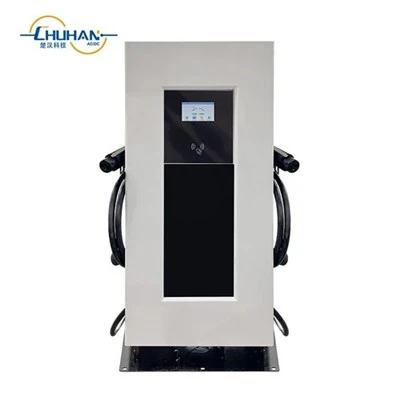
If the "commercial" load is mainly vehicles, a general-purpose cabinet may be the wrong shape. CHUHAN also publishes integrated storage-and-charging units.
The 60 kW / 65 kWh all-in-one DC cabinet is a smaller charging-led system, described with RFID, app, and OCPP control; sister listings also refer to an IP54 rating and a dual-gun CCS / GB/T option. The ACT-DC-186kWH+120kW is a larger outdoor station: 186 kWh of storage, 120 kW output, liquid cooling, dual guns, and IP55 protection, with a graphic listing a DC output of 200–1000 V and dual CCS connectors. Sister listings also refer to PV input, AC 380 V backup charging, and CCS1 / CCS2 / GB interfaces. Applications shown for that station include highway service areas, commercial parking, fleet and logistics depots, and industrial parks.
These units are not a substitute for a 50 kWh workshop cabinet, and the cabinet is not a substitute for them. If the site already has a strong grid connection and simply needs two parking bays to charge quickly, a grid-only DC charger such as the ACT-DC-160SH (160 kW, dual-gun, 200–1000 V, OCPP) may be the cleaner offer, with storage added only if the connection or the tariff requires it.
When a large liquid-cooled cabinet or a container is justified
Jump further only when the coincidence of load is actually large. The public catalogue also includes a 215 kWh class (UniEnergy P10), a 262 kWh class (UniEnergy MAX10), a 419 kWh liquid-cooled cabinet listed at 215 kW, and a 5 MWh-class liquid-cooled container with an installed capacity of 5.031 MWh, a rated power of 2,515 kW, and a two-hour charge/discharge duration, in a 20-foot container format.
Those figures belong on industrial parks, plants, and projects that have already measured a long, high load, not on a first quote for a single workshop that wanted "some backup and a place to charge one van." A container is a project in itself: space, foundations, grid connection, and a commissioning plan. It should not be the default answer to the word "commercial."
What to send with the enquiry
When you ask CHUHAN to help place a C&I storage quote, include:
- The job: peak shaving, backup, solar shifting, EV support, or a stated mix
- A daytime and evening load sketch, even if it is still approximate, in kW
- How many hours the customer expects the system to cover at that load
- Whether vehicles will charge on the same connection, and at what power
- Outdoor space, access, and whether an IP54 or IP55 cabinet can be placed where it will actually stand
- Whether a charger is already specified, or should be integrated with the storage
CHUHAN manufactures hybrid inverters, LiFePO4 storage, and AC and DC EV chargers in our factory in Yueqing, Zhejiang. If you share the job and the load window, we can help you start at the 50 kWh-class cabinet, move to a storage-and-charging station, or step up to a larger BESS - without skipping the middle of the catalogue.
Website: https://www.chinachuhan.com/ Email: sales03@chinachuhan.com WhatsApp: +86 189 6895 8968