

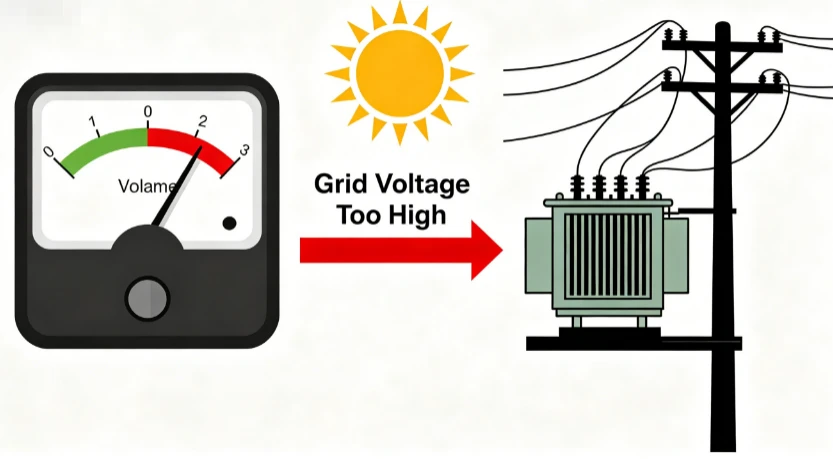
Cause 1: Grid voltage too high or too low
Symptoms
Error messages like "Grid Over Voltage", "Grid Under Voltage", or "Grid Out of Range". Typically occurs during peak solar generation hours (midday) and recovers in the evening.
Explanation
Grid-tied inverters must synchronize with grid voltage. When voltage exceeds the allowed range (e.g., single-phase 230V system allows ±10% = 207–253V), the inverter trips. Common in:
- Long distance from transformer (high line impedance)
- Many PV systems in the same distribution area pushing voltage up at noon
Solutions
- Contact utility to adjust transformer tap
- Adjust inverter's voltage protection threshold (requires installer password & local permission)
- Install a voltage stabilizer or use an inverter with wider voltage range
Cause 2: Overheating (internal temperature too high)
Symptoms
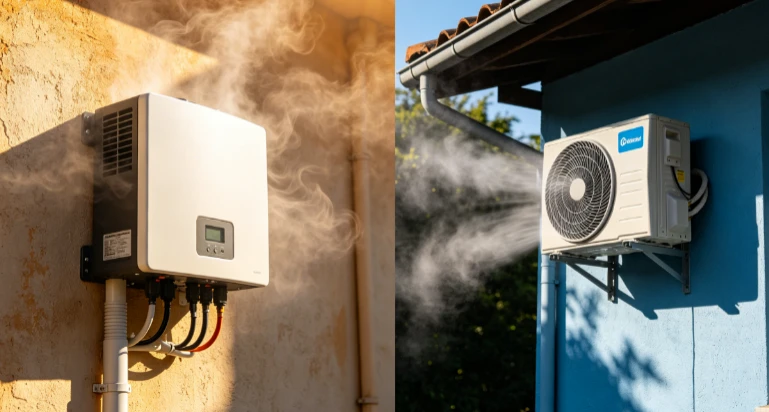
Inverter trips frequently at noon or during hot summer days. The casing is very hot to touch; fan noise may be loud or absent. Error: "Over Temperature", "Derating".
Explanation
Electronic components generate heat. Poor cooling leads to internal temperatures exceeding design limits (typically 80–90°C), triggering thermal protection. Common causes:
- Inverter installed in direct sunlight
- Poor ventilation (blocked cooling vents)
- Fan failure or dust clogging
Solutions
- Install inverter in a shaded, well-ventilated area (e.g., north wall or under eaves)
- Clean cooling fans and heat sinks every 6 months
- Replace faulty fans
Cause 3: Low DC side insulation resistance (ground fault)
Symptoms
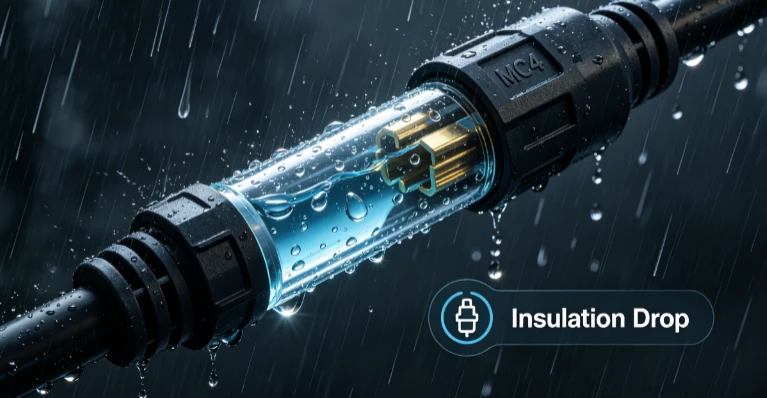
Errors: "Isolation Fault", "GFCI", "PV Insulation Resistance Low". Often appears on rainy, foggy, or early morning days.
Explanation
The inverter measures insulation resistance between PV positive/negative and ground. When resistance falls below threshold (usually <1MΩ), it trips due to leakage risk. Common causes:
- Damaged DC cables or wet MC4 connectors
- Module frames not properly grounded
- Moisture in combiner box
Solutions
- Inspect DC cables and connectors; replace damaged parts
- Ensure module frames and mounting structure are reliably grounded
- Use a megohmmeter to measure insulation resistance and locate faults
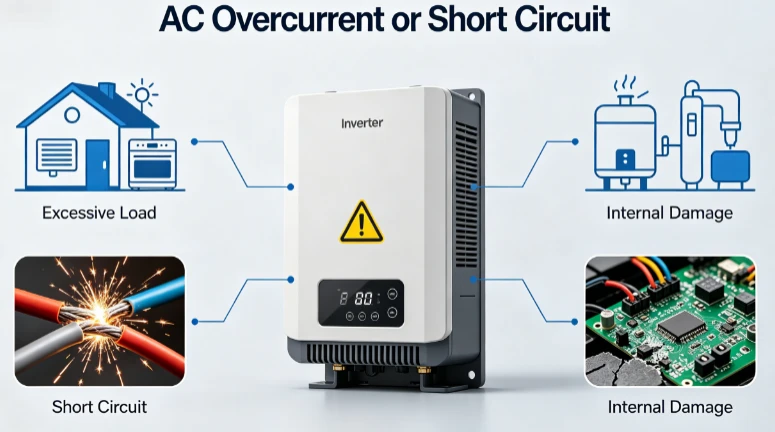
Cause 4: AC overcurrent or short circuit
Symptoms
Inverter trips under heavy load. Errors: "Over Current", "Short Circuit". Normal operation with light or no load.
Explanation
Output current exceeds inverter rating (e.g., 5kW inverter max ~22.7A at 230V). Possible causes:
- Total home load exceeds inverter capacity (AC + water heater + oven)
- Line short circuit or leakage between phase and neutral
- Internal output module damage
Solutions
- Calculate simultaneous peak load – confirm it's within inverter rating
- Have an electrician check output wiring and distribution box
- If external causes are ruled out, contact manufacturer for inverter repair
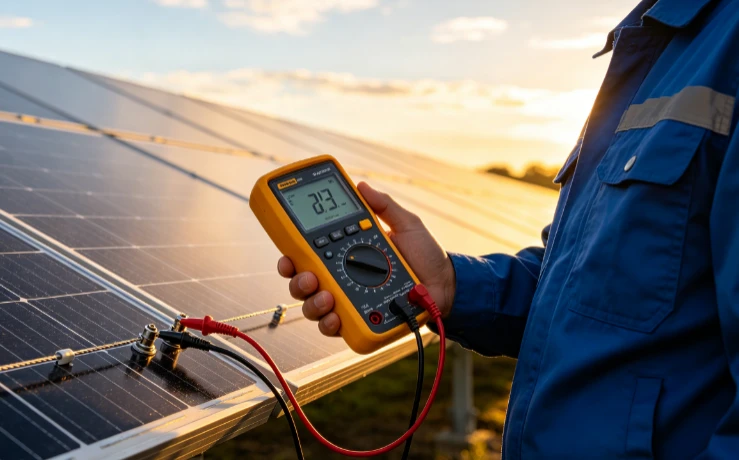
Cause 5: PV string DC overvoltage
Symptoms
Inverter trips on cold mornings, error "PV Over Voltage", "Input Over Voltage". May recover as temperature rises at noon.
Explanation
Solar panel open-circuit voltage (Voc) increases as temperature drops. On a cold, clear morning, voltage may exceed inverter's maximum DC input voltage (e.g., 500V or 600V limit). Causes:
- Too many panels connected in series per string
- High-voltage panels (60/72 cells) used without accounting for low-temperature coefficient
Solutions
- Redesign string sizing – ensure max voltage at lowest historical temperature stays below inverter limit
- Replace with an inverter that has higher input voltage rating
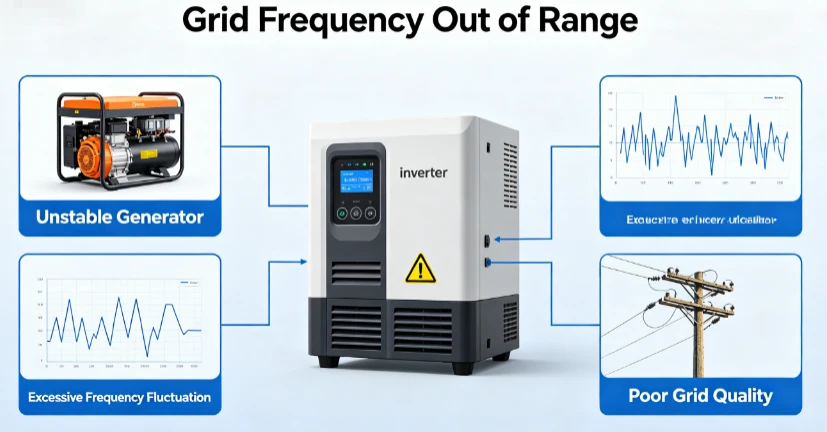
Cause 6: Grid frequency out of range
Symptoms
Error: "Grid Frequency Out of Range", "Freq Out". Common in areas with unstable grids.
Explanation
Grid-tied inverters track grid frequency (50Hz or 60Hz, typically ±0.5-1Hz tolerance). When frequency fluctuates excessively (e.g., diesel generator supply, large load switching), the inverter trips.
Solutions
- For microgrids or generator supply, balance generator loading
- Check grid quality with utility
- For off-grid or hybrid systems, adjust frequency tolerance settings (requires expert guidance)
Cause 7: Inverter hardware failure (aging capacitors, relay welding, etc.)
Symptoms
Intermittent tripping with inconsistent error codes; may work briefly after restart then fail again. All external checks are normal.
Explanation
Internal components like electrolytic capacitors, relays, IGBTs degrade over time. Common in inverters older than 5 years.
Solutions
- Try factory reset or firmware update
- Contact manufacturer for repair or replacement
- If inverter is near or past its design life (typically 10-12 years), consider replacing with a new model
Quick diagnostic table (7 causes summary)
| Cause | Typical error | When it happens | Quick check |
|---|---|---|---|
| 1. Grid voltage | Grid Over/Under Voltage | Midday/peak generation | Measure grid voltage at connection point |
| 2. Overheat | Over Temperature | Summer noon | Touch casing, check fan |
| 3. Low insulation | Isolation Fault | Rainy/humid days | Measure DC-to-ground with megohmmeter |
| 4. Overcurrent | Over Current | Heavy load | Disconnect loads one by one |
| 5. DC overvoltage | PV Over Voltage | Cold mornings | Measure string open-circuit voltage |
| 6. Frequency | Freq Out of Range | Unstable grid | Check grid frequency log |
| 7. Hardware | Various codes | Random | Try known-good replacement |
Real case: Why did my inverter keep tripping every noon?
Background: User in Foshan, Guangdong. 3kW grid-tied system. Inverter tripped at exactly midday for a month.
Diagnosis:
- Error displayed: "Grid Over Voltage"
- Measured grid voltage at noon: 256V (allowable: 253V)
- Contacted utility – too many PV systems on same transformer
- Utility adjusted transformer tap; voltage dropped to 238V – tripping stopped
Conclusion: High grid voltage is one of the most common reasons why a solar inverter keeps tripping.
Frequently Asked Questions (FAQ)
Q1: Why does my solar inverter keep tripping but my neighbor's same system works fine?
A: Possible reasons: your inverter has stricter voltage thresholds; your wiring is farther from the transformer; or your inverter has a hardware issue.
Q2: Should I manually restart the inverter immediately after tripping?
A: Not recommended. First note the error code, wait 10-15 minutes for capacitors to discharge. If the issue is grid-related, it will auto-recover. Forced repeated restarts may damage the inverter.
Q3: Why does my inverter report insulation faults on rainy days?
A: Rain can seep into cable connectors or combiner boxes, lowering DC insulation resistance to ground. It usually recovers when dry. If persistent, check waterproof sealing.
Q4: Will inverter tripping damage my solar panels?
A: Generally no. Tripping only stops energy conversion; panels still generate voltage but no load. However, frequent tripping can accelerate inverter aging.
Q5: What should I do if my ChuHan Technology inverter keeps tripping?
A: First follow the external checks (causes 1-6) above. If a hardware fault is confirmed, contact our technical support team (phone/email/WhatsApp). We provide remote diagnostics and warranty service.
Final thoughts
The next time you ask yourself "why does my solar inverter keep tripping", go through the 7 causes step by step. Over 80% of tripping issues stem from grid voltage anomalies, overheating, or insulation faults – often fixable without replacing the inverter.
If this guide helped you, please share it with others. For further assistance, ChuHan Technology offers free remote troubleshooting.
👉 Need remote assistance from an engineer?
Submit your inverter error photo below, and we will reply within 24 hours.
Wechat/whatsapp: +86 189 6895 8968


