Every inverter turns DC battery power into the AC power your appliances expect. But not all AC is created equal. A pure sine wave inverter reproduces the smooth, clean waveform of the grid, while a modified sine wave inverter produces a cheaper, blockier approximation. That single difference decides which appliances run happily, which ones hum or overheat, and whether a sensitive device is safe to plug in at all. If you are buying an inverter for home backup, an off-grid cabin, a vehicle, or a job site, this is the one decision worth getting right before anything else.
WHAT THE TWO WAVEFORMS ARE
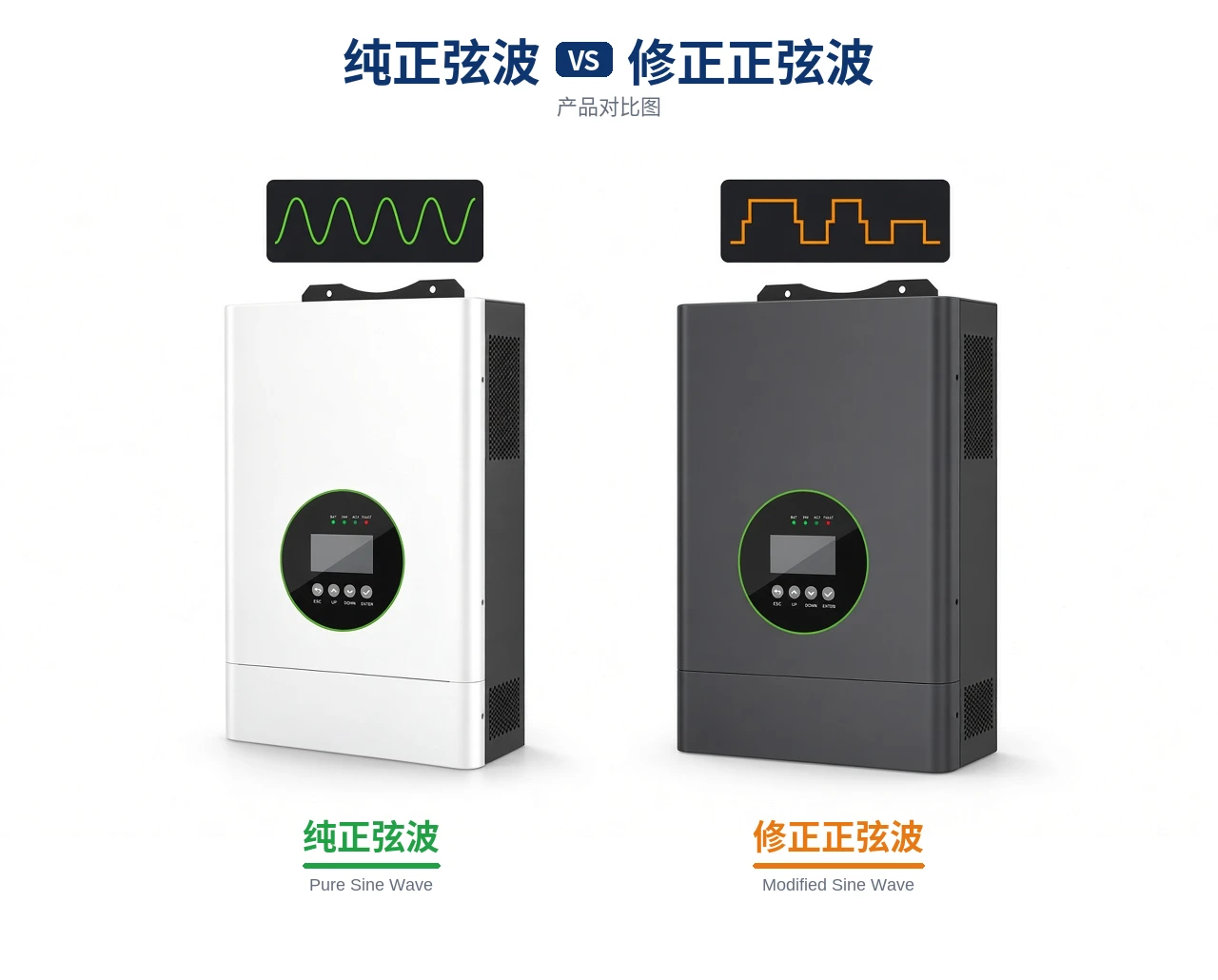
The electricity from the grid is a pure sine wave. Voltage rises and falls in a smooth, continuous curve, crossing zero 50 or 60 times per second depending on your country, and every appliance on the market was designed to run on that exact shape.
A pure sine wave inverter reproduces this shape almost perfectly. The output is so close to grid power that connected devices cannot tell the difference. A modified sine wave inverter, by contrast, steps the voltage up and down in a rough staircase or block pattern that only approximates the sine curve. It is sometimes called a "quasi-sine wave," but the honest name is a modified square wave-it delivers the right average voltage, but in abrupt steps rather than a smooth curve.
WHY THE SHAPE MATTERS
Most AC loads only care about the total power delivered, and for simple heating elements and basic electronics, the rough shape works fine. But three kinds of devices actually "read" the waveform and behave badly when it is not smooth:
Motors
A modified sine wave contains harmonic distortion-extra frequencies that the motor does not need. Motors convert this unwanted energy into heat and vibration, so they run hotter, draw more power, and can wear out faster.
Transformers and power supplies
Many devices contain small transformers or switch-mode supplies that expect a clean sine. On a modified wave they can hum or buzz audibly, and some may fail to start.
Timing circuits
Anything that uses the AC frequency as a clock-digital clocks, some coffee makers, older appliances-can run fast or slow because the stepped waveform disrupts the timing reference.

HOW MUCH DISTORTION?
Engineers measure how "clean" an AC waveform is using total harmonic distortion, or THD. A pure sine wave inverter typically produces less than 3 to 5 percent THD, essentially the same as the grid. A modified sine wave inverter commonly sits at 20 to 40 percent THD or more. That number is a useful shorthand: the higher the THD, the more of your battery power is being delivered as heat and noise instead of useful work.
WHAT NEEDS A PURE SINE WAVE
As a rule, choose a pure sine wave inverter if any of these will ever be connected:
Motor-driven appliances
refrigerators, freezers, air conditioners, well pumps, furnace fans, and power tools.
01
Audio and video equipment
anything you do not want to buzz or hiss.
02
LED and dimmable lighting
some dimmers and LED drivers flicker or fail on a modified wave.
03
Medical devices
CPAP machines, oxygen concentrators, and other health equipment should always run on pure sine power.
04
Modern electronics with delicate power supplies
laser printers, some TVs, gaming consoles, and computers.
05
WHAT IS FINE ON A MODIFIED SINE WAVE
Modified sine wave inverters are not bad products-they are just built for a narrower job. They work acceptably for simple, resistive, or non-motor loads such as:
- Incandescent and basic resistive lights.
- Simple battery chargers and phone chargers.
- Basic power tools with universal motors, though they may run slightly warmer.
- Simple resistive heaters, toasters, and small kitchen appliances.
If your entire load list looks like this, a modified sine wave inverter will save you money and do the job.
COST, EFFICIENCY, AND NOISE
Modified sine wave inverters are cheaper to build, and that saving is passed on-they often cost 30 to 50 percent less than a comparable pure sine wave unit. The trade-off is not just compatibility. Because the stepped waveform contains distortion, a modified sine inverter is typically a few points less efficient, and any connected motor or transformer wastes extra power as heat. Pure sine wave inverters also run quieter, with less audible hum and less electrical noise that can interfere with radios or sensitive circuits.
HOW TO CHOOSE
Start with your load list, not the price tag. If you will only ever run basic lights, chargers, and simple tools, a modified sine wave inverter is a sensible, economical choice. But if there is any chance of connecting a motor, a medical device, audio gear, or modern electronics, choose a pure sine wave inverter-the price difference is small next to the cost of replacing a damaged appliance or a device that simply refuses to start.
For most home backup, off-grid, and RV applications today, a pure sine wave inverter is the default recommendation, because modern homes are full of exactly the loads that a modified wave upsets.
FAQ

Q: What is the difference between a pure sine wave and a modified sine wave?
Q: Is a modified sine wave inverter bad?
Q: Do I need a pure sine wave inverter for my refrigerator?
Q: Can I run a CPAP machine on a modified sine wave inverter?
Q: Are pure sine wave inverters more expensive?
Q: How do I know which type an inverter is?
The transition to electric mobility is an irreversible trend, and robust infrastructure is the cornerstone supporting this shift. At Wenzhou Chuhan Technology, we are proud to be a Tier-1 integrator and source manufacturer in the new energy sector.
Whether you are an operator, distributor, or individual buyer, and whether you require highly reliable EV Chargers, efficient Solar Inverters, or durable Energy Storage Systems, we provide highly competitive hardware and customized solutions tailored to your needs.
Contact us today to get our latest product catalog and an exclusive quote. Let's empower global sustainable transportation together.
Phone Number
+86 137 5889 3452
sales07@chinachuhan.com