Solar power has become the cheapest source of electricity in history, and battery storage has followed the same downward curve - lithium-ion battery pack prices have fallen roughly 89% since 2010, reaching about $139 per kilowatt-hour (kWh) by 2023, according to BloombergNEF. That single trend has put solar-plus-storage within reach of ordinary households and small businesses, whether they live in a city apartment, a suburban home, or a cabin hours from the nearest power line.
But "going solar" is not one decision - it is a family of decisions, and one of the first is how your system will relate to the electricity grid. Inverters come in three broad types: off-grid, grid-tied, and hybrid. Each one answers a different question, and choosing the wrong one is an expensive mistake. This article explains what each type does, the situations where each makes sense, and how to decide which one fits your home or business.
WHICH INVERTER DO YOU NEED: OFF-GRID, GRID-TIED, OR HYBRID?
The answer comes down to two questions: do you have a grid connection, and do you want backup power when the grid goes down? If you have no grid at all, you need an off-grid inverter. If you have a reliable grid and simply want to cut your electricity bills, a grid-tied inverter is the simplest and cheapest option. If you have a grid but also want to keep the lights on during an outage, a hybrid inverter is the one to choose.
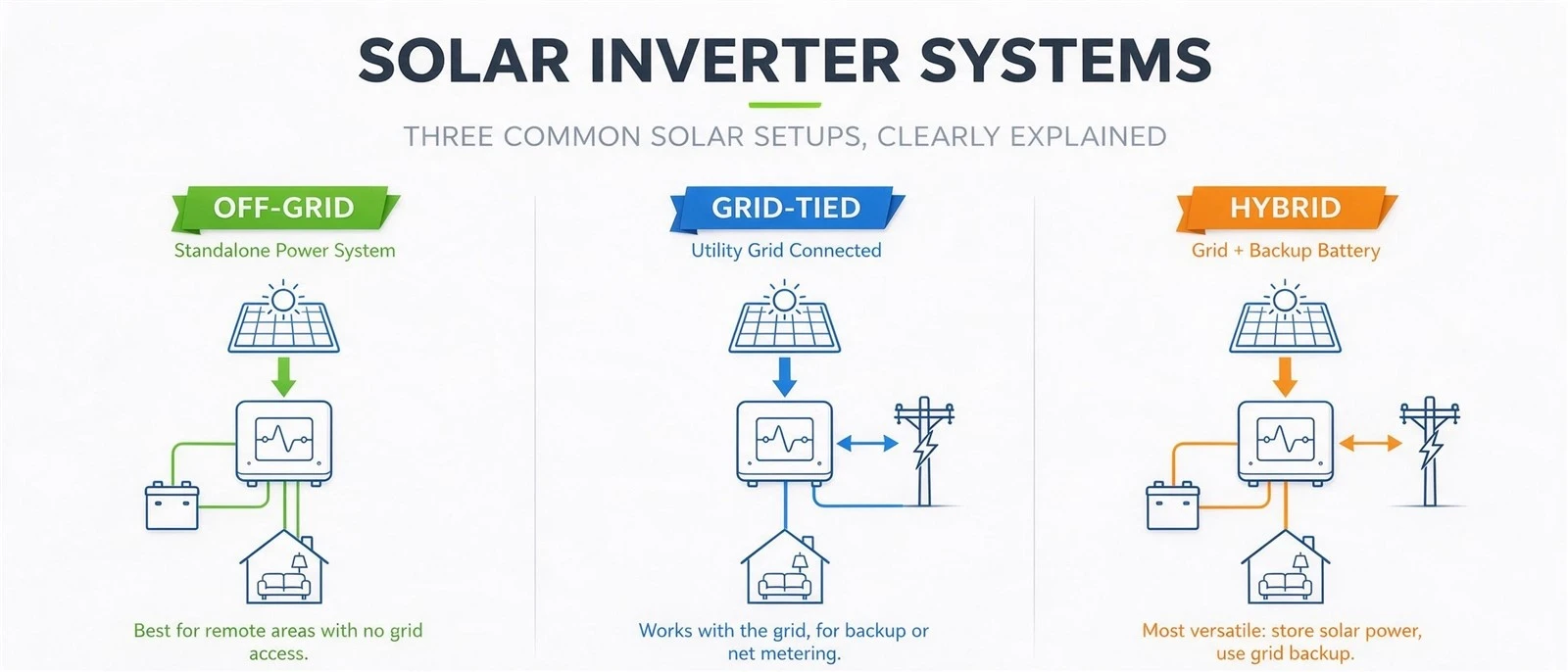
WHAT IS AN OFF-GRID INVERTER?
An off-grid inverter runs a property that is not connected to the electricity grid at all. Solar panels charge a battery bank, and the inverter converts that stored direct-current (DC) power into the alternating current (AC) your appliances use. The battery is not optional in an off-grid system - it is the heart of the setup, because it is the only thing keeping power flowing at night, on cloudy days, or whenever the panels are not producing.
Because there is no grid to fall back on, off-grid systems are sized carefully. The battery bank has to cover your worst-case energy needs, not your average day, and most off-grid homes also keep a backup generator for extended bad-weather stretches. This makes off-grid systems the most expensive to design per kilowatt-hour, but for properties where running a power line is impossible or prohibitively costly, they are the only practical choice.
WHAT IS A GRID-TIED INVERTER?
A grid-tied inverter connects your solar panels directly to the electricity grid, with no battery in between. During the day, solar power runs your home first, and any surplus is exported to the grid - often in exchange for credit through a program like net metering or a feed-in tariff. At night or on cloudy days, you simply draw power from the grid as usual.
The defining feature of a grid-tied inverter is that it shuts down automatically when the grid goes down. This is a safety requirement called anti-islanding: the inverter must stop feeding power into the grid during an outage so that utility workers repairing the lines are not electrocuted. The practical consequence is that a grid-tied system without a battery will not power your home during a blackout, even if the sun is shining.

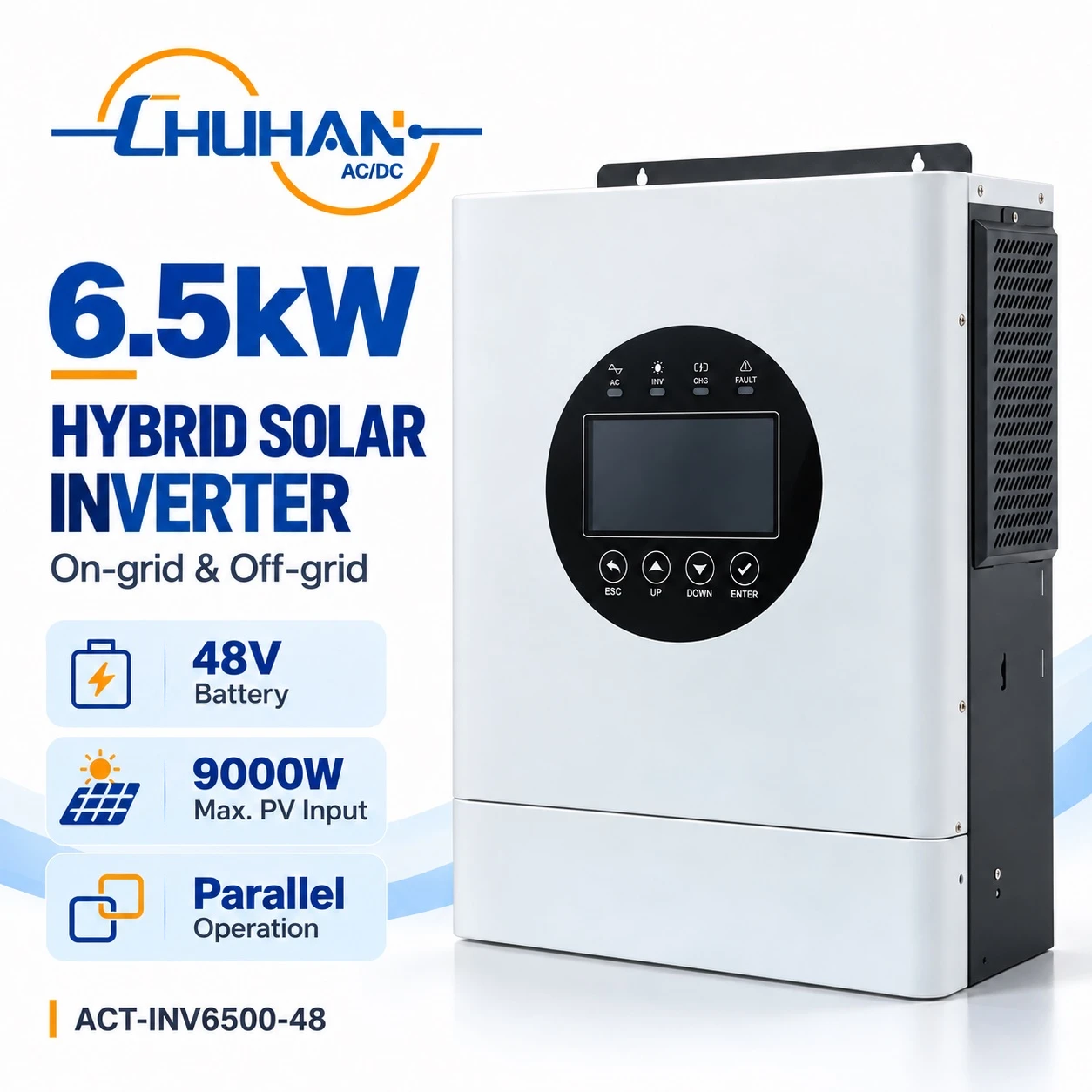
A hybrid inverter combines both worlds. It connects to the grid, manages your solar panels, and charges a battery bank - all in one unit. When the grid is up, it behaves like a grid-tied system, routing solar power to your loads and exporting the surplus. When the grid fails, it switches to battery power automatically, often within a few milliseconds, so your essential appliances keep running.
Hybrid inverters are also the most flexible option for managing energy costs. With a battery, you can store cheap solar power during the day and use it during the evening peak, when grid electricity is most expensive - a strategy called peak shaving or time-of-use shifting. For households that want both bill savings and blackout protection, the hybrid inverter is usually the answer.
WHY THE CHOICE MATTERS MORE THAN IT USED TO
Two trends have made this decision more consequential. The first is battery cost. BloombergNEF's figures show lithium-ion pack prices falling about 89% since 2010, and modern lithium iron phosphate (LiFePO4) batteries - the chemistry most home systems now use - are rated for roughly 6,000 charge cycles, which can translate to well over a decade of daily use. Falling costs mean the battery that once made hybrid systems unaffordable is now a realistic option for many households.
The second trend is grid reliability. More frequent storms, heat waves, and aging infrastructure have made power outages a growing concern in many regions. A hybrid inverter's ability to keep the essentials running during an outage has moved from a nice-to-have to a primary reason people buy solar in the first place.
The three options also sit on a clear cost curve. A grid-tied inverter is the least expensive because there is no battery; an off-grid system is the most expensive because its battery bank must be large enough to ride through the worst days alone; and a hybrid system sits in the middle, letting you start with grid-tied savings and add storage as your budget allows.
OFF-GRID: WHERE THERE IS NO GRID
Off-grid systems are built for places the grid does not reach. Remote cabins and vacation homes, farms and ranches far from the nearest line, boats and recreational vehicles, and rural or developing regions where extending the grid is too expensive all rely on off-grid power. If the cost of running a power line to your property runs into the tens of thousands of dollars, an off-grid solar system can pay for itself before the trench is even dug.
GRID-TIED: WHERE BILLS ARE THE GOAL
Grid-tied systems suit properties with a reliable grid connection and a simple goal: spend less on electricity. Because there is no battery, the system is smaller, simpler, and cheaper to install, and it reaches payback sooner. This is the default choice for urban and suburban homes that rarely lose power and want the fastest return on their solar investment.
HYBRID: WHERE BACKUP AND SAVINGS BOTH MATTER
Hybrid systems are for homes that want grid-tied savings plus the safety net of backup power. They make sense wherever outages are frequent, where electricity prices vary by time of day, or where the homeowner wants to be more self-sufficient without cutting the cord entirely. A hybrid inverter can also be a stepping stone: you can add battery storage as your budget allows, rather than committing to it all at once.
HOW TO CHOOSE: THREE COMMON SITUATIONS
Most decisions come down to one of three situations.
OPTION 1: CHOOSE OFF-GRID WHEN THERE IS NO GRID CONNECTION.
If your property has no grid access, or the cost of connecting is prohibitive, an off-grid inverter is the clear choice. Size the battery bank to cover your worst days, and consider a generator for extended stretches of bad weather.
OPTION 2: CHOOSE GRID-TIED WHEN THE GRID IS RELIABLE AND COST IS THE PRIORITY.
If you have a stable grid connection and rarely experience outages, a grid-tied inverter gives you the simplest, cheapest path to lower electricity bills. Accept that you will lose power during an outage - that is the trade-off for the lower cost.
OPTION 3: CHOOSE HYBRID WHEN YOU WANT BACKUP POWER AND FLEXIBILITY.
If you want to cut bills and keep the lights on during an outage, a hybrid inverter with a battery is the best of both. It costs more up front, but the battery's falling price and the peace of mind it provides have made it the most popular choice for new home solar installations.
GOVERNMENT INCENTIVES FOR SOLAR AND STORAGE
Whichever type you choose, government incentives can lower the cost. In the United States, the federal Residential Clean Energy Credit provides a 30% tax credit for qualifying solar and battery storage systems, valid through 2032, and it generally applies to the inverter and battery equipment as well. In the United Kingdom, the Smart Export Guarantee pays homeowners 4 to 15 pence per kilowatt-hour for surplus electricity exported to the grid. Other countries and states offer their own rebates, grants, and feed-in tariffs, and these change frequently - so it is worth checking what is available in your area before you buy.
FAQ

Q: Do grid-tied inverters work during a power outage?
Q: Is an off-grid system cheaper than a grid-tied system?
Q: Can I add a battery to a grid-tied inverter later?
Q: Can a hybrid inverter run my home when the grid is down?
Q: How do I know which type is right for me?
The transition to electric mobility is an irreversible trend, and robust infrastructure is the cornerstone supporting this shift. At Wenzhou Chuhan Technology, we are proud to be a Tier-1 integrator and source manufacturer in the new energy sector.
Whether you are an operator, distributor, or individual buyer, and whether you require highly reliable EV Chargers, efficient Solar Inverters, or durable Energy Storage Systems, we provide highly competitive hardware and customized solutions tailored to your needs.
Contact us today to get our latest product catalog and an exclusive quote. Let's empower global sustainable transportation together.
Phone Number
+86 137 5889 3452
ales07@chinachuhan.com