

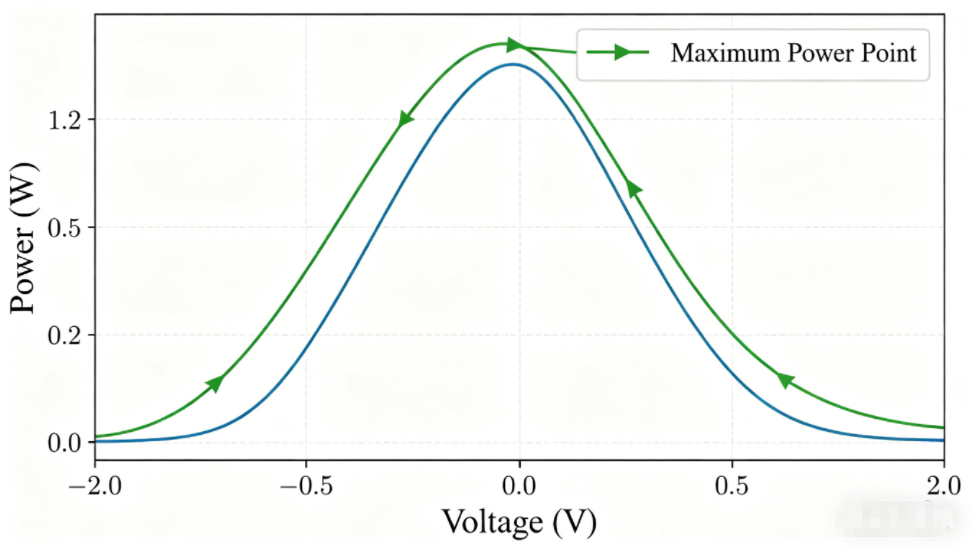
What MPPT Actually Does
MPPT stands for Maximum Power Point Tracking. Fancy name. Simple job.
A solar panel does not produce a fixed amount of power. It produces different amounts depending on sunlight, temperature, shading, and even how dirty the glass is. At any given moment, the panel has one optimal operating point where it produces the most power. That point changes constantly as clouds move, the sun shifts, or a leaf falls across one corner of the panel.
The MPPT circuit inside your inverter hunts for that optimal point. It adjusts voltage and current continuously to keep the panel operating at its peak.
Without MPPT, your panels would just dump whatever they happen to produce. You would lose 20 to 30 percent of your potential output. With MPPT, you get most of what the panel can deliver.
Think of it like a car's transmission. You could drive everywhere in second gear. The engine would run, and the car would move. But you would waste gas and go slower than you should. MPPT is like having a good transmission that always picks the right gear for the road.
Why One Tracker Is Not Enough
Here is where many budget inverters cut corners. They have a single MPPT tracker. All your panels connect to it as one big group.
That works fine if every panel gets the exact same sunlight at the exact same time. South-facing roof, no shade, clear sky all day. That situation exists on paper. It almost never exists in real life.
Shade – A chimney, a tree branch, or a vent pipe can shade one panel while the rest are in full sun. With one MPPT tracker, the whole string of panels drops to the level of the shaded panel. One shadow kills production across the whole array.
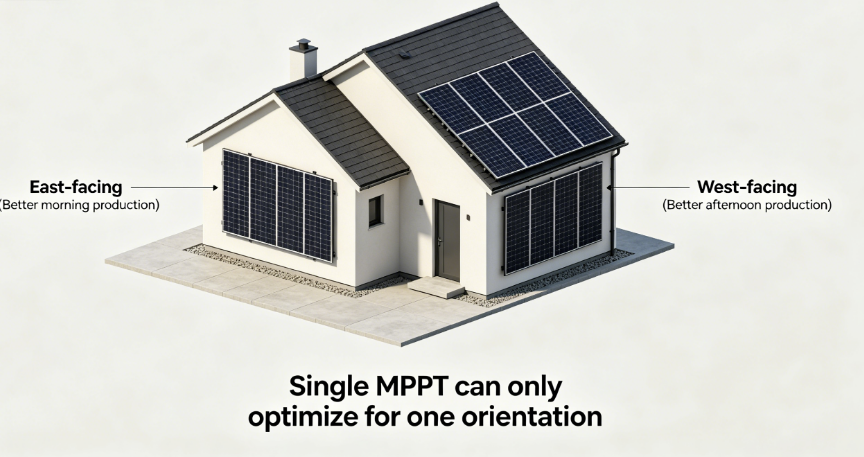
Different orientations – Maybe your roof has faces east and west. Or you have panels on two separate buildings. One tracker cannot handle two different sun exposures. You end up optimizing for one and losing on the other.
Cloudy days – Clouds do not move evenly across a roof. One part of your array might catch a break in the clouds while another sits under shadow. A single tracker cannot take advantage of that partial sun.
I have seen systems with one MPPT lose 15 to 20 percent of their annual production compared to identical systems with two MPPT trackers. That loss does not show up on any single day. It adds up over years.

Multiple MPPT Trackers: The Fix
Multiple MPPT trackers split your solar array into independent zones. Each tracker does its own hunting for the optimal power point. Shade on one zone does not affect the others.
A simple example. You have panels on two roof faces. East side gets morning sun. West side gets afternoon sun. With one MPPT, you have to choose which side to optimize. The other side underperforms all day.
With two MPPT trackers, each side runs independently. East side produces well in the morning. West side produces well in the afternoon. You get good production from both. Over a full day, you might capture 10 to 15 percent more energy than a single-tracker system.
Same panels. Same roof. Same weather. Just better electronics.
Three or four trackers give you even more flexibility. You can separate panels by orientation, by shade patterns, or even by panel type if you expand your system later.
What We Do at Wenzhou Chuhan
Our inverters come with two to four MPPT trackers depending on the model.
Residential models (3kW to 10kW)
Two MPPT trackers
Each tracker handles up to 6,000W of solar panels
Good for most homes with one or two roof orientations
Commercial models (15kW to 110kW)
Three or four MPPT trackers depending on the specific model
Each tracker handles up to 15,000W to 20,000W
Designed for complex roofs, multiple buildings, or ground-mounted arrays
All our MPPT circuits operate at 99.5 percent efficiency or better. That means the tracking itself loses almost nothing. The limit is what your panels can produce.
We also support wide input voltage ranges. Our residential inverters start tracking at 120V and keep going up to 550V. Our commercial models go up to 1,000V. That gives you flexibility in how you string your panels.
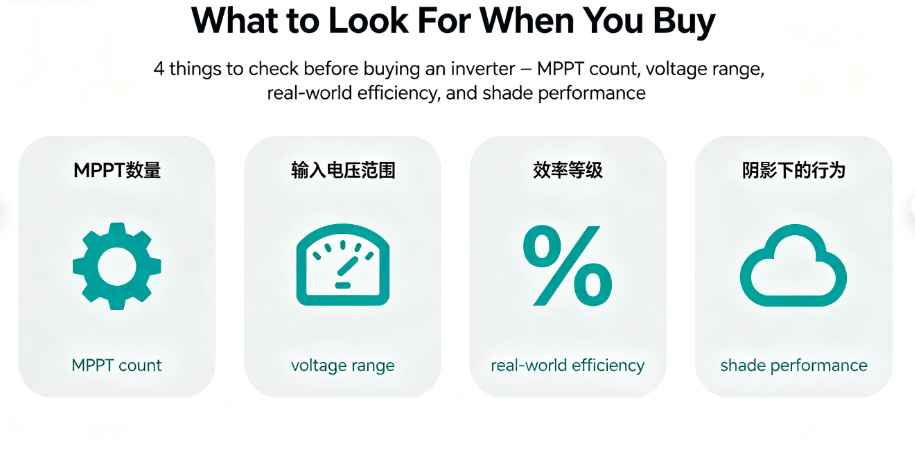
What to Look For When You Buy
If you are shopping for an inverter, here is what I would check:
Number of MPPT trackers – Two is the minimum for any residential system worth installing. Four is better for complex roofs or larger systems.
Input voltage range – Wider is better. A low startup voltage means your system starts producing earlier in the morning. A high maximum voltage gives you more stringing options.
Efficiency rating – Most good inverters claim 98 to 99 percent efficiency. That number includes the MPPT circuit plus the DC to AC conversion. The real question is whether they hit that number in real conditions, not just in a lab at 25 degrees Celsius.
Real-world behavior – Ask the supplier how the inverter handles partial shade. Some cheap inverters oscillate when tracking in shade. They hunt back and forth instead of locking onto the optimal point. Good inverters have algorithms that settle quickly and stay stable.
A Quick Test You Can Do
If you already have an inverter, here is a simple test. Cover one panel in your array with a piece of cardboard on a sunny day. Check your production before and after.
With a good multi-tracker inverter, you will see a small drop. Only the affected zone loses power.
With a single-tracker inverter, you will see a large drop. The whole array drops to the level of the covered panel.
That difference is what you lose every time a cloud passes, a tree grows, or a shadow moves across your roof.
The Bottom Line
MPPT is not marketing hype. It is the difference between a solar system that performs and one that disappoints.
One tracker is better than none. Two trackers are better than one. Four trackers give you room to expand and handle complex installations.
At Wenzhou Chuhan, we build inverters with multiple MPPT trackers because we have seen what happens when customers buy cheap single-tracker units. They call us a year later, frustrated that their system never meets expectations. By then, the savings from buying cheap have been eaten up by lost production.
We would rather sell you the right inverter the first time.
If you have questions about MPPT, about sizing your inverter, or about which of our models fits your project, reach out through our website at www.chinachuhan.com. We respond within 24 hours.
About Wenzhou Chuhan Technology CO,.LTD
Founded 15 years ago, Wenzhou Chuhan Technology CO,.LTD focuses on the investment, construction, operation, and renovation of new energy, microgrids, and zero-carbon parks. The company provides design solutions and services for DC-side products including charging piles, energy storage systems, inverters, and photovoltaics. Wenzhou Chuhan holds certifications including CCC, CB, TUV, KC, and SAA for power electronics, with operations spanning new energy, photovoltaics, energy storage, and charging.
Visit us: www.chinachuhan.com


