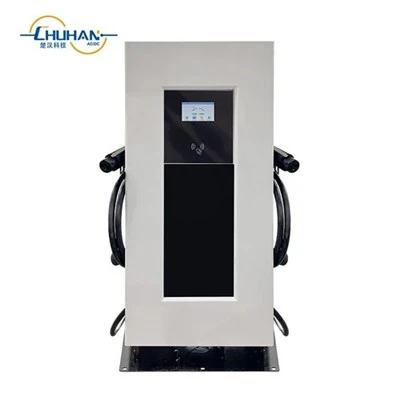
A DC charging enquiry often arrives as a single number: 40 kW, 160 kW, 240 kW, or 720 kW. That number does not tell you how the site will be built. One project wants a floor-mounted cabinet with the guns on the same body, sitting at the edge of a small yard. Another wants a central power room and dispensers spread along a row of bays, with power shared between them. If you quote only the kilowatt class, you can buy the wrong layout and still be "on spec."
Lock the layout before you lock the model.
kW is the class, not the construction
Write one sentence on page one of the quote: integrated cabinet, or split system with a remote power cabinet and separate dispensers. Everything else - gun count, connector, and even the exact power step - is easier after that sentence exists.
An integrated cabinet keeps the power electronics and the charging points in one floor-mounted body. It suits a site with a few parking positions, a short cable run, and no room (or no appetite) for a separate plant room. A split system puts the power conversion in a central cabinet and places dispensers out on the apron. It suits a depot or a public row where the vehicles are spread out and the operator wants to share a larger power block between bays.
These are not marketing names for the same product. They change civil works, cable length, heat, and how you talk about "how many vehicles can charge at once."
When an integrated cabinet is the cleaner quote
For a workplace car park, a dealer forecourt, or a small logistics yard that only needs one or two DC positions, start with a named integrated cabinet from the public range and keep the drawing compact.
Public examples on the CHUHAN English site:
- ACT-DC-40DD: a 40 kW floor-mounted dual-gun DC cabinet, with a 200–1000 V adjustment range, 0–250 A, IP54, and RFID / app / OCPP on the public description.
- ACT-DC-160SH: a 160 kW dual-gun DC fast charger, a common step when the site can accept a larger single cabinet.
- ACT-DC-240SDC: a 240 kW-class DC unit aimed at heavier vehicles, still in the integrated-station conversation rather than a split power room.
These units are quoted as cabinets you place, connect, and operate at that bay. If the buyer later wants six or eight positions around a yard, do not keep multiplying 160 kW cabinets in silence. That is the moment to ask whether a split 480–960 kW-class system is the better layout.
A 60 kW / 65 kWh all-in-one DC charger with storage is still an integrated body, with a battery in the same equipment. It does not, by itself, decide a split-apron design.
When a split power room is the better starting point
If the enquiry is a fleet depot, a bus parking row, or a public site that already talks about several dispensers and a shared power block, look at a split-type station rather than forcing a row of standalone cabinets.
The ACT-DC-720KW is a 720 kW split-type DC fast charging station, one option in a 480 / 600 / 720 / 960 kW family. The public offer describes a floor-mounted central power cabinet with multiple dispensers, CCS, a DC output window of 150–1000 VDC, a maximum single-module current of 250 A, IP54, input of 380 VAC ±15% (three-phase five-wire), 50 Hz, operating temperature from −20°C to +65°C, system efficiency of at least 95%, a power factor of at least 0.99, and intelligent power sharing.
Two details in that list should appear on the quote, not only in a brochure:
- Power sharing: the 720 kW is a block to be distributed, not a promise that every dispenser delivers 720 kW at the same time.
- Module current and voltage window: 250 A and 150–1000 VDC tell you what the vehicle side can take; they do not replace a layout drawing.
Do not invent a gun rating or a dispenser count if the buyer has not given you one. Ask how many positions they want on the apron, and whether the power cabinet can sit in a plant room or must stand in the yard.
Storage-coupled charging is a third layout
If the site is short on grid capacity, or the buyer already wants a battery in front of the chargers, say so as a third architecture. The 186 kWh / 120 kW and 261 kWh / 160 kW liquid-cooled cabinets, and a 5 MWh / 2.5 MW class container, are not accessories you bolt onto a 720 kW split station after the purchase order. They are a different system conversation. Likewise, a house hybrid and a 5.12 kWh wall pack will not turn a depot enquiry into a "solar charging" quote. Keep that job on its own drawing.
Grid headroom still matters, but it is a check after the layout is named: if the transformer cannot accept a 160 kW or 720 kW block, the discussion is about a smaller integrated cabinet, a staged install, or a storage-coupled design - not about renaming the same SKU.
What to send with the enquiry
To quote the right DC layout, include:
- Site voltage and supply type (typically 380 V three-phase for these cabinets - confirm what is actually at the board)
- Power class you have in mind (40 / 160 / 240 / 720 kW, or a range) and whether you want an integrated cabinet or a split power room with remote dispensers
- How many charging positions, and the connector you need if already known
- Quantity and the destination country
- Whether storage must sit in front of the chargers, and any known limit on grid capacity
Wenzhou physical factory · inverters / energy storage / EV chargers · customizable.
Email: sales03@chinachuhan.com
WhatsApp: +86 189 6895 8968
Website: www.chinachuhan.com